Before I get accused of a misleading title, allow me to explain. A perfectly reasonable interpretation of the title of this track would be that I loaded up a 60 minute sample of the ocean and ran it through a granular processor. Though without explanation up front one might form that expectation, I want to state up front that this patch is not that, and thwart that expectation forthwith. This patch is a fully synthesized piece where every created sound was manufactured using fairly pedestrian techniques, and finished off with some reverb.
Coming off of my last patch, I was in a good place. I used a swelling technique that has become a core part of my practice. Combine that with using chaos as a sequencer (of sorts) for playing one shot piano samples, another core technique I use as a matter of regularity, plus experimenting with a module that I’ve left almost completely unexplored until now, and I felt at ease. But after having made the patch there was something that I felt like I needed to do.
As I was patching up and tinkering with the swells portion of “Going Home” I noticed something that I wanted to record as a piece of sound art, but that wasn’t appropriate for the immediate task at hand. I tweak my patches a lot. Once I find something I like, I listen, then make changes to more closely hone in on that sound I hear in my head. I could be adjusting any number of facets of a particular sound from setting basic levels or modifying timbres, to precisely calibrating CV signals into that perfect range for the exact modulation I was hoping to find. Most of the time, this process takes a lot of time. And while engaged in this process during Going Home I noticed just how much Swell Physics changed over time. As I noted in the post,
By the time I decided that I was going to modulate Swell Physics I had already been working on the patch for a while. Swell Physics had morphed significantly over time, well over an hour, but as those transitions happened slowly, there were long periods reminiscent of cyclic patterns. No two sets of waves were exactly alike, but neither was any given set drastically different from those immediately before or after. Change happened on a longer timeline than your average ambient piece takes to perform.
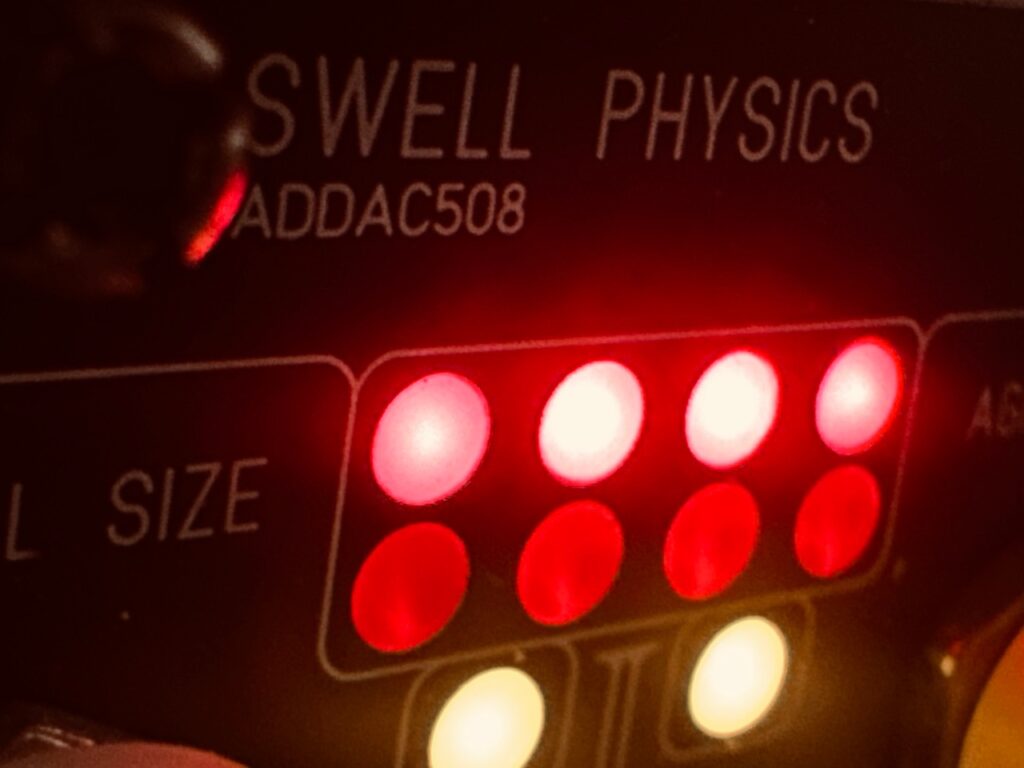
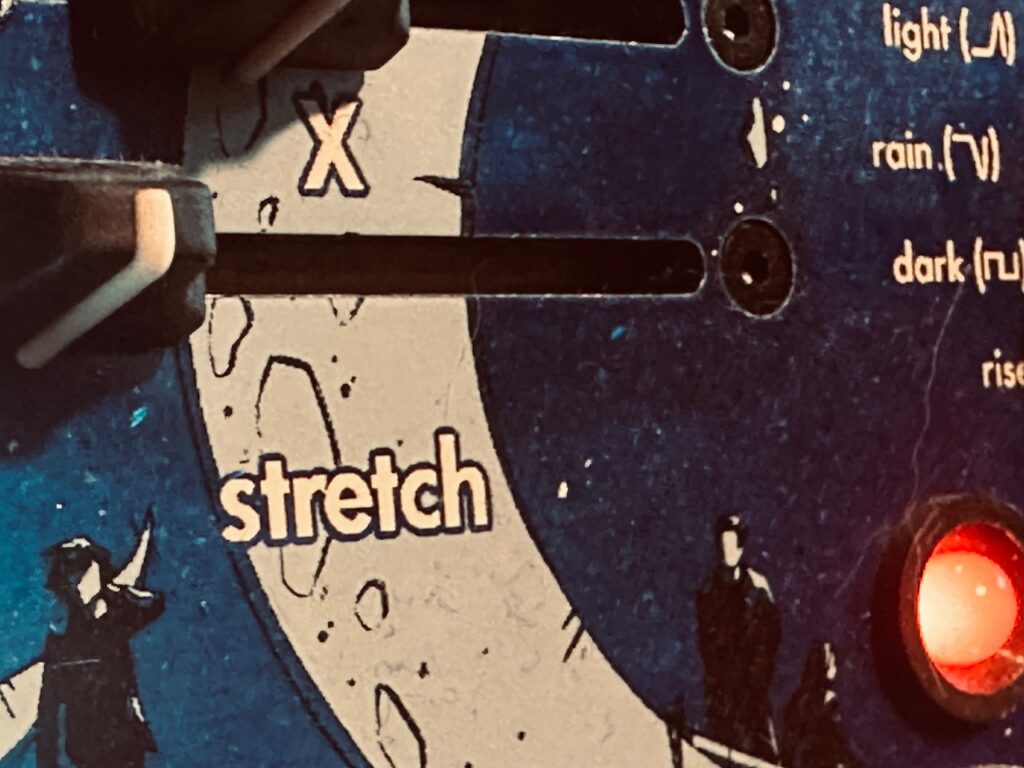
The Addac508 Swell Physics is a wild module. It’s been one of my favorites for as long as I’ve had it. I’ve made sure to pack it in a tight travel case several times despite other modules perhaps having more flexible utility in that spot. I’ve managed to use it in a fair number of patches, including two that will be on an upcoming EP to be released in a physical format 😉. Having grown up on a coast, I’ve always loved the ocean, and I’ve always found its rhythms hypnotizing. Having the ability to create my own oceans of sound has been a great inspiration for me in my practice, and I can only hope that I can expand the number of ways in which I might use Swell Physics.
Having already explained the sounds thoroughly in the last post, I won’t belabor to do it again, but I will note several changes….
Being that the entirety of the point of this patch was to emphasize the swells created by Swell Physics, I wanted to tone down in some of the growl. I re-patched both the output from the Humble Audio Quad Operator and Bizarre Jezabel Quarté Mk2 separately so that I might have a more particular dry/wet mix level. When running the two in series as an insert, Quad Operator > Quarté Mk2, the options are limited to either a 50/50 or a 0/100 dry/wet mix. It’s just a switch. And while that works for a lot of things, in other scenarios you might want more control. This was one of those times, and I mixed in the dry/wet mix to about 67/33, give or take. I also adjusted the LPG offset to something under full open, while also adjusting both the delay time and feedback for each channel. I wanted texture without any real added growl. I wanted to impart some of the character of those untuned PT2399 chips, but much less than in the previous patch. I also wanted to adjust the one moving harmonic so that it both moved much slower, and within a smaller range. I tried a couple of different methods for moving that harmonic, including using a Sample and Hold so that the note changed each time the wave rose above 0v, but ultimately used the same method as previously,1 only with a much more limited range of CV.
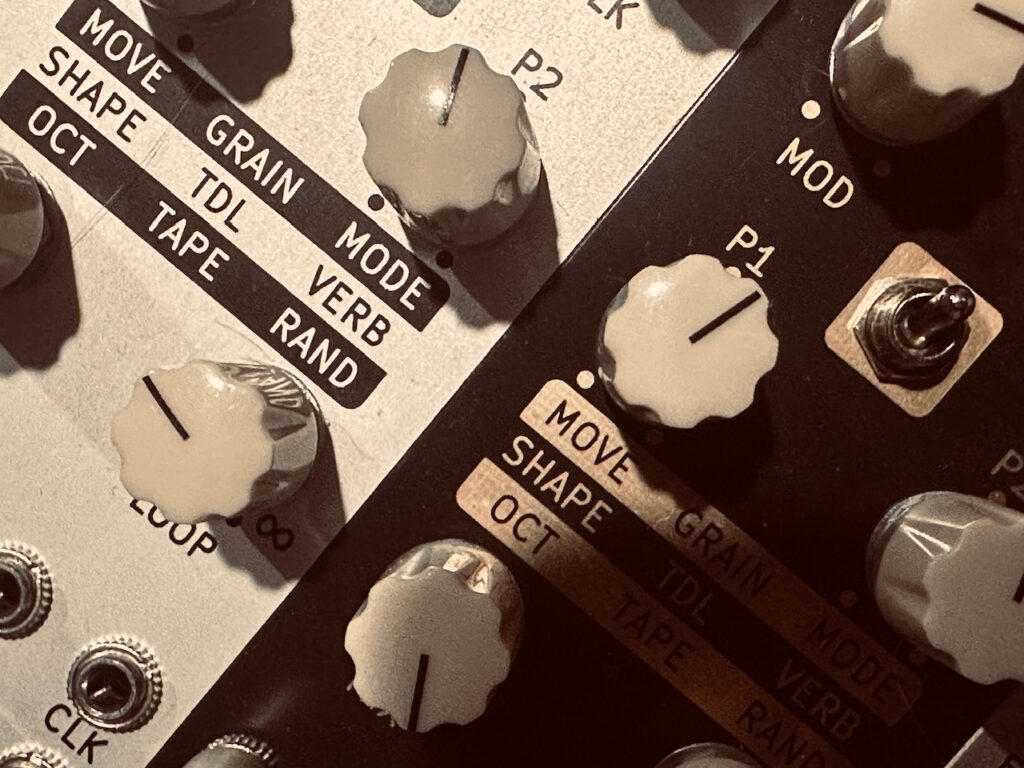
I patched the newly mixed swells into the Pladask Elektrisk Dradd(s) set to Grain mode, which I returned a fully wet output straight to the mixer. Although the result of removing the dry signal was a loss in clarity, the sound gained a texture that only fully wet granular synthesis can provide. It was as if individual drops from each wave could be heard dancing their way amongst the rest, finally amalgamating in the deep, octave down reverb.
The last several patches I’ve made have felt labored. Forced. A product of trying too hard in the wrong sorts of ways. In trying so hard to do something clever, I’ve fallen away from the music I love producing the most. That’s not to say I don’t like those patches, or that I’ve somehow gone to another sonic universe completely foreign to me. I actually like them a lot, and I’ve used plenty of familiar techniques. But it is to say that they never seemed to feel quite right. In that light I wanted to use a technique that I can only describe as home. Slow moving waves that control the levels of various oscillators. I initially considered using noticeably different timbres for each of those voices, but ultimately chose to keep the core of the patch as simple as possible, primarily using techniques I’ve used often. Many timbres or sounds in patches like these are a really nice touch when using this swelling technique, and is likely to be explored soon. But I wanted to strip this patch as far down as I could.
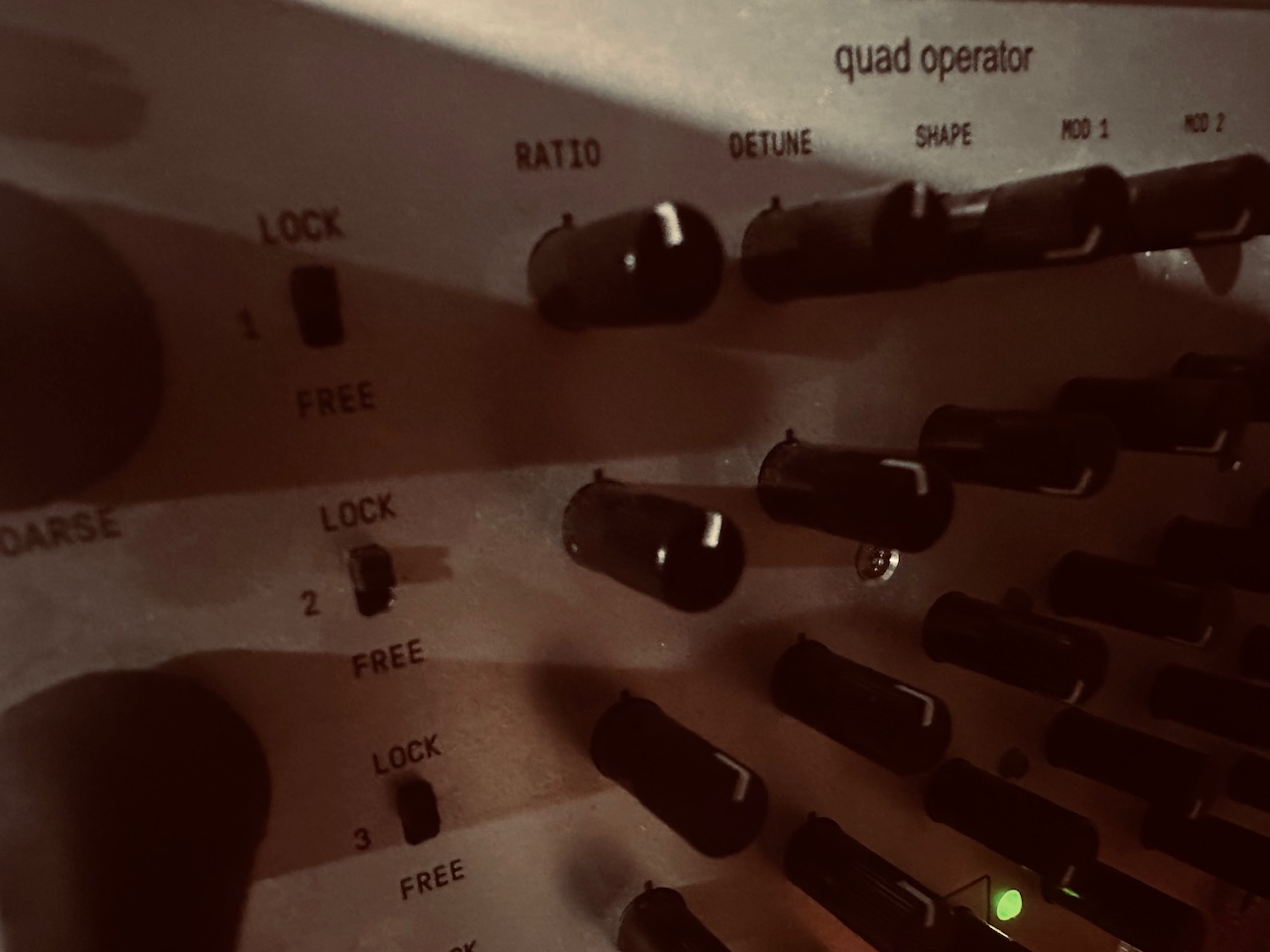
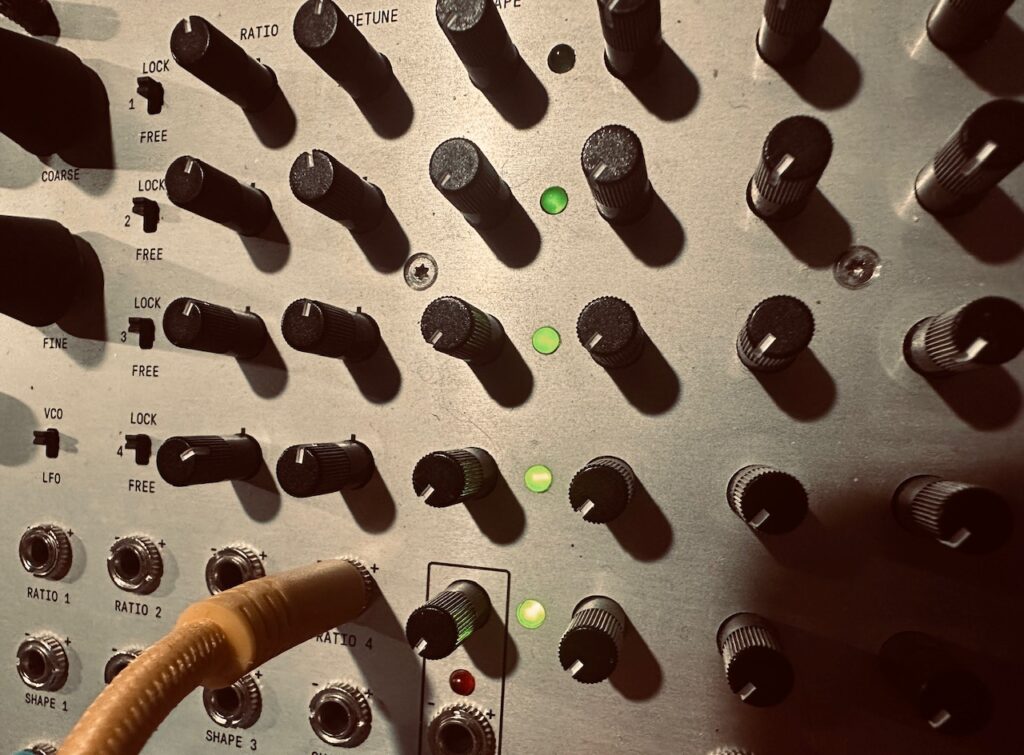
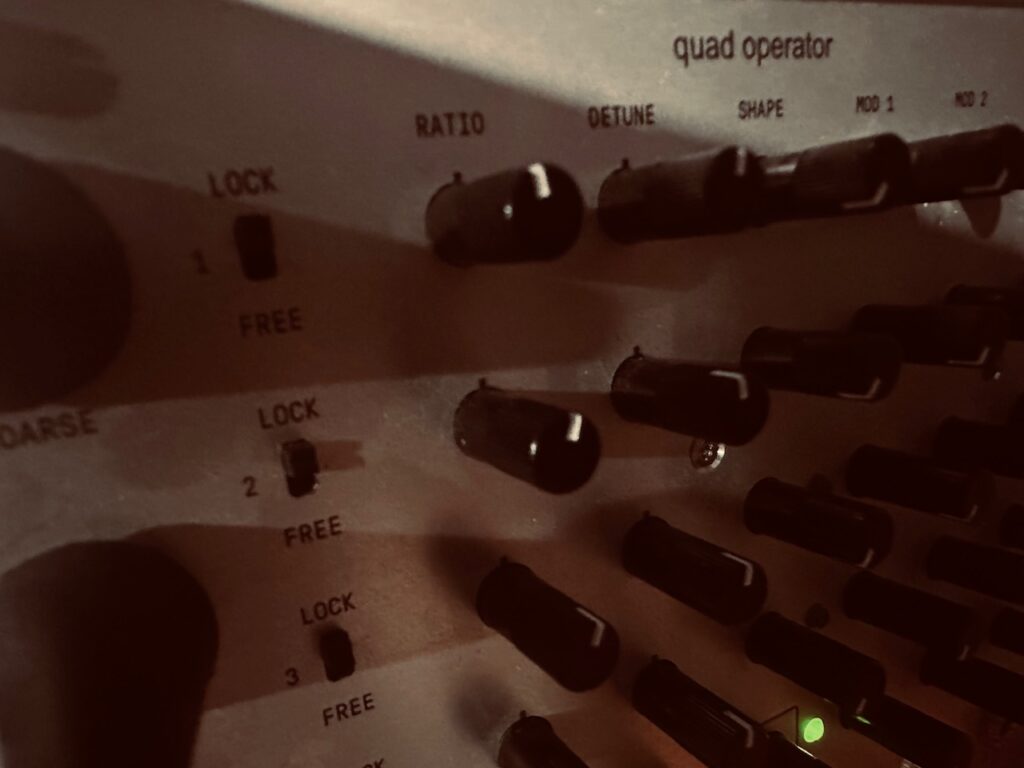
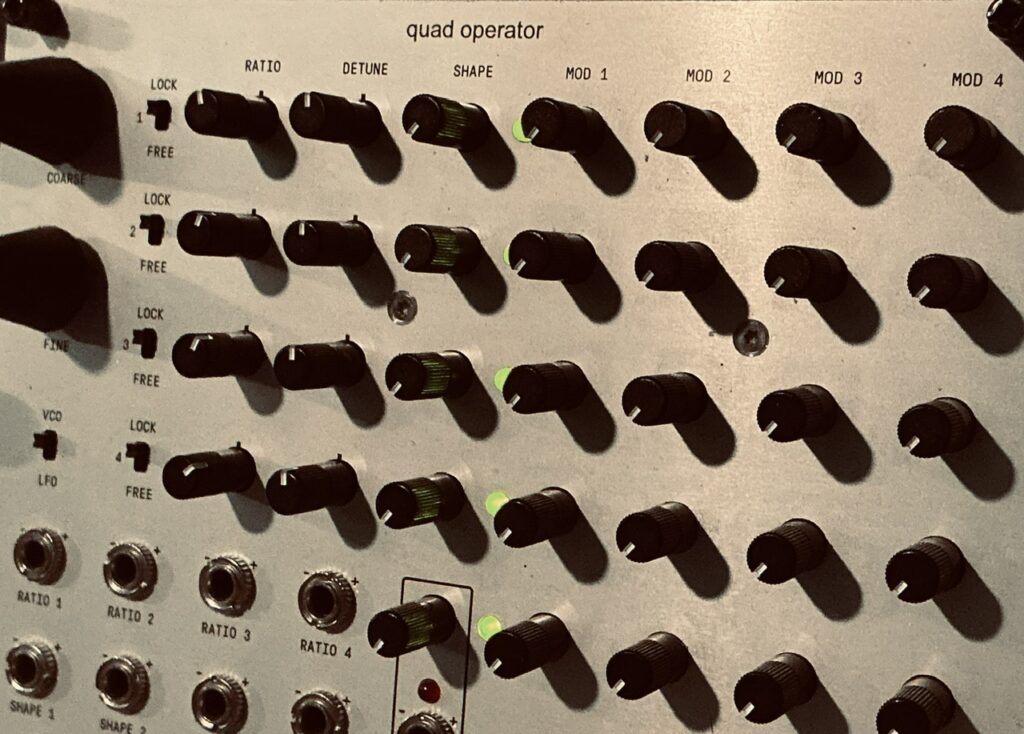
This patch started with the always fun Addac Systems Addac508 Swell Physics. Everything in the patch is somehow influenced by its five outputs. Swell Physics controlled levels of the four oscillators of the Humble Audio Quad Operator, and provided four control voltages to exert a substantial amount of influence over the Nonlinearcircuits How’s The Serenity? , which in turn was fed back to Swell Physics to form a symbiotic loop of chaotic goodness. Even parameters within the patch that aren’t directly controlled by Swell Physics are heavily influenced by it.
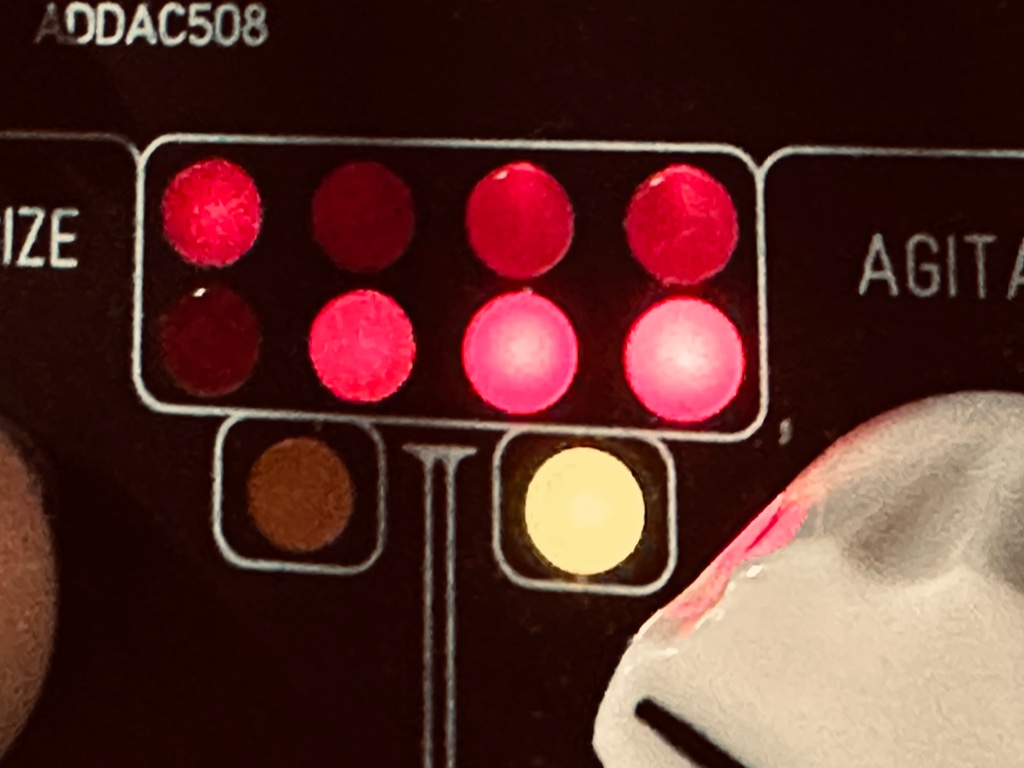
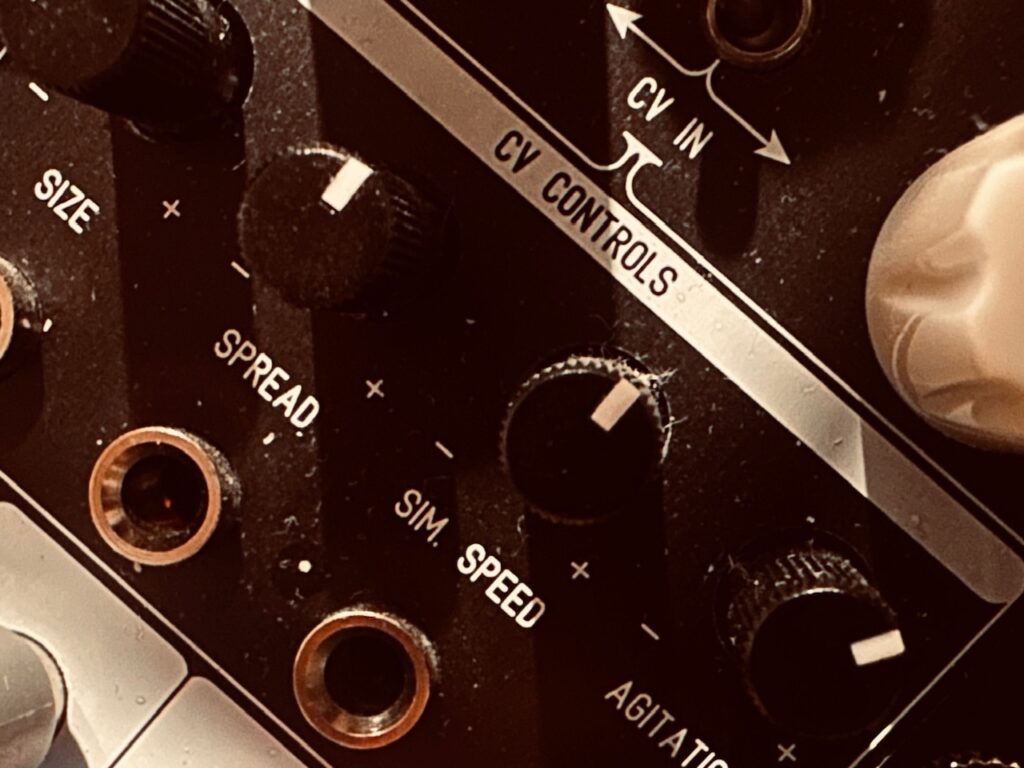
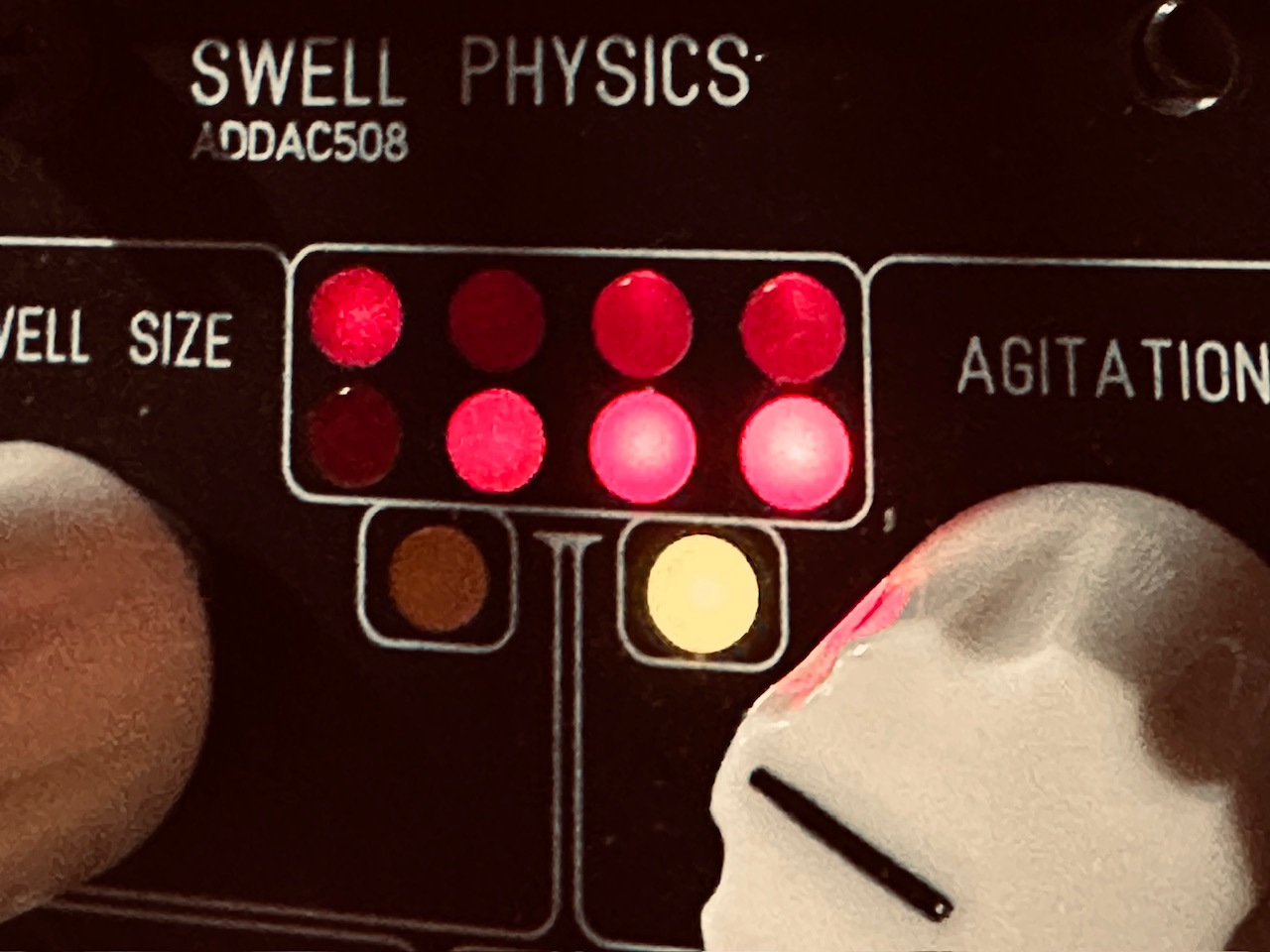
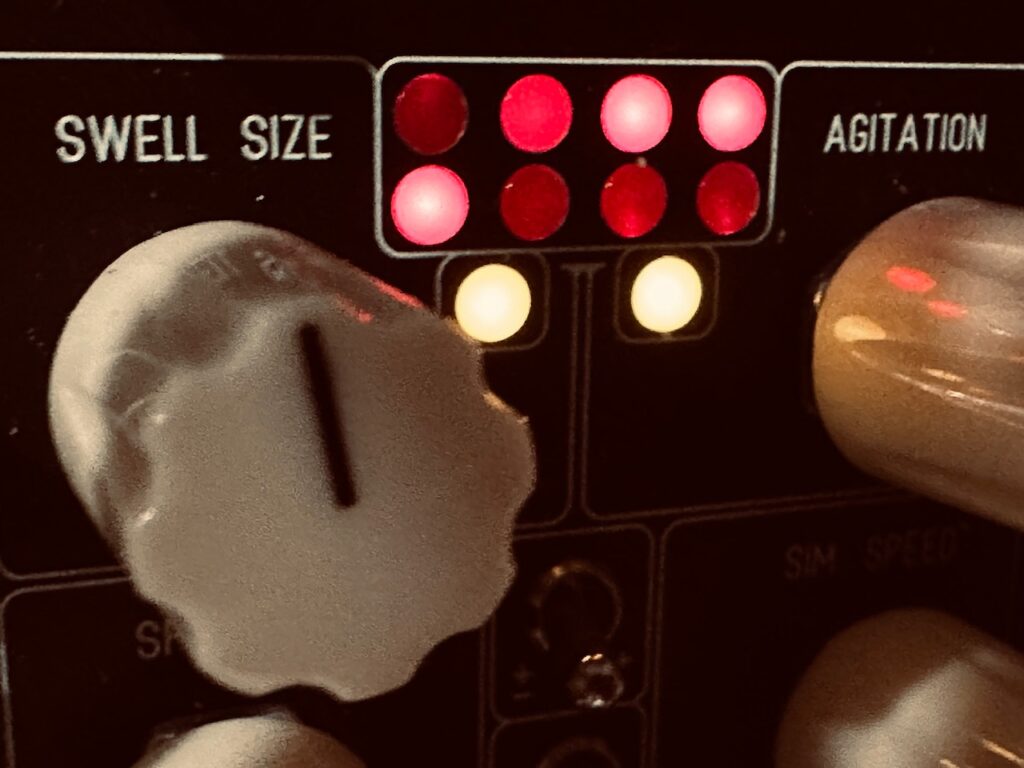
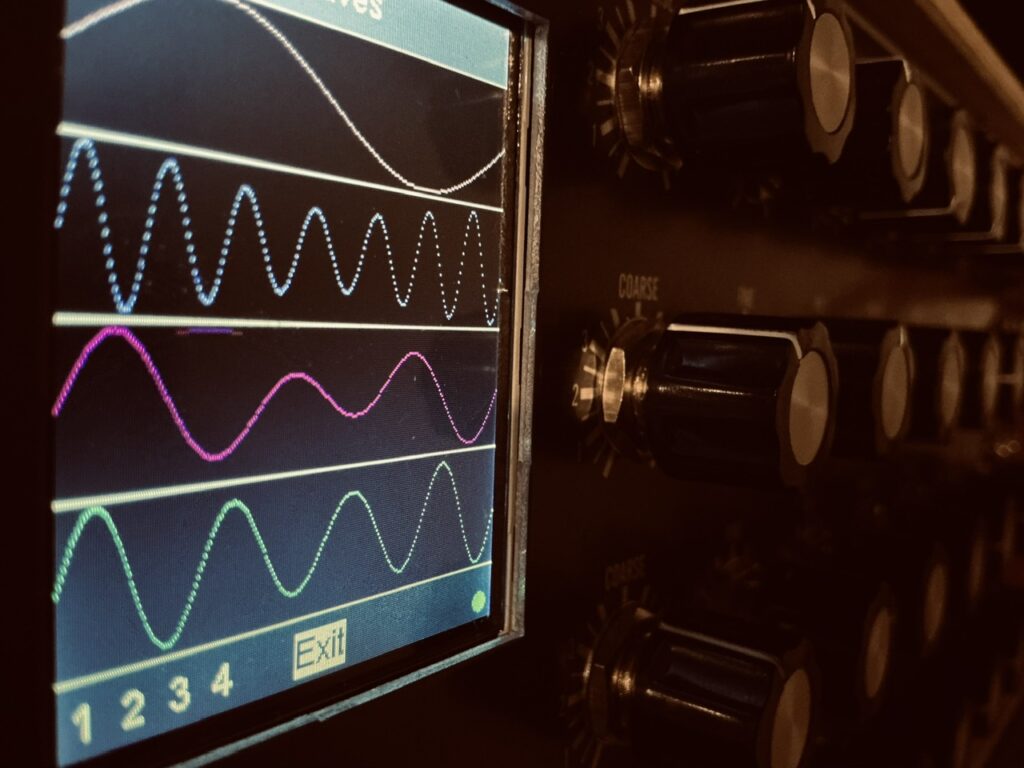
At its core, Swell Physics is a fancy name for a nifty chaos module that mimics the movement of the ocean. Its behavior would be determinative, except that each wave is in turn affected by the others, by the amount of Agitation within the system, the distance apart each wave is from the next, and many other facets. The ocean is a complex array of moving waves where everything both influences, and is influenced by, everything else nonlinearly. In short, waves in the ocean don’t act independently. There are currents, other waves, wind, biologics, the sea floor, and probably many more points where each wave is somehow changed. Waves crash into one another, overtake or are overtaken by other waves, and subject to barometric pressure, etc. Waves move and change in time. Swell Physics has been a bedrock modulator since I got it a couple of years back and first began exploring its capabilities. And although I’ve branched out and used Swell Physics in many different ways in various patches, and indeed here, the core of this patch reaches back to those earliest experiments whereby it controlled the level of oscillators to create an ocean of sound; each wave rising and falling with the flow of the ocean. Quite often when I use Swell Physics, I’ll use it raw and without any modulation. Over time there’s still more change than one can reasonably discern. But this time was different.
By the time I decided that I was going to modulate Swell Physics I had already been working on the patch for a while. Swell Physics had morphed significantly over time, well over an hour, but as those transitions happened slowly, there were long periods reminiscent of cyclic patterns. No two sets of waves were exactly alike, but neither was any given set drastically different from those immediately before or after. Change happened on a longer timeline than your average ambient piece takes to perform. I wasn’t dissatisfied with the overall change, but I wanted to hurry the process along some so that the time scale for being able to hear and recognize significant change was in terms of just a few minutes, and not over an hour or more (that sort of thing will come soon). One natural force of the ocean that has a noticeable affect on waves is wind. As an avid SCUBA diver through the late 90s and early 2000s with a whole lot of underwater time logged and a whole lot more sitting on the deck of a boat, I’ve seen the wind whip up the ocean in the matter of minutes. With just the shift of a breeze, what once was a plate of glass as smooth as a swimming pool can quickly be transformed into a heave-inducing chop that can beat you to hell. A simple change in wind direction can take gentle bobs and turn them into huge swells. I wanted to simulate wind, and decided chaos was the best tool I have for the job. Like the ocean, wind is also a chaotic process. Deterministic, but not cyclical because of nonlinear processes that act upon the atmosphere. Wind, after all, is waves in a different medium. Plugging all four outputs into How’s The Serenity?, so that Swell Physics would exert a substantial amount of influence on its subject, and then using just one How’s The Serenity? output to feed back to the Agitation CV input on Swell Physics made a drastic difference immediately. Waves seemed to turn over on themselves, and both peaks and lulls of each wave became more pronounced before again pulling back and mellowing out. It was as if wind gusts quickly moved in and out. The effect was palpable.
In the interest of simplicity I chose to use simple sine waves as the core sound of the patch. Sine waves are very often my preferred base point. Not because I don’t like upper harmonics, but because I tend towards additive synthesis over subtractive. I just seem to like the sorts of timbres I can get from different additive processes more than filtered and processed complex waveforms, even when those forms of adding harmonics aren’t part of a more standardized toolkit for additive synthesis. Many artists will tend towards frequency, phase, amplitude, or ring modulation, which are highly useful when trying to get a more specific sound like bells, chimes, congas, or gongs. Others will lean on wavefolding or some other form of waveshaping to properly stack harmonics on top of a sine wave. Some are super adventurous and go all the way and try to stack more sines on top. And even though I’ve used all of those methods of adding upper harmonics, I tend towards other ways like distortion, bit/samplerate reduction, or, as is the case with this patch, harmonics added via dirty delay chips like the venerable PT2399 in the Bizarre Jezabel Quarté Mk2. While this might not be a generally accepted form of additive synthesis,1 I think it fits the criteria, if not the strict definition. (Almost) Everything starts with simple sines, and harmonics are added on top via one process or another.
But I wasn’t quite done. While the waves were beautiful, I still felt like something was missing. I wanted a bit more movement. With an older patch in mind, I decided to try a technique I’ve used a couple of times with the Synthesis Technology E370, but had neglected to even think about it with anything else. With only the flash of an idea in mind I patched the Average output from Swell Physics to the Ratio input on Operator 3 of the Quad Operator so that as that harmonic would play, it would slowly meander up and down through the various upper harmonics of the fundamental, creating movement not only in volume, but in pitch as well. This decision was money, creating a sort of melody to follow the waves as they moved up and down from crest to trough. I also used the same Average signal to pan that one harmonic in the stereo field from left to right. As pitches got higher, the signal would move further to the right, and as pitches went downwards, the sound would move back left.
For this track I wanted something simple, yet not basic. I’ve done many patches like this using nothing but sines, and generally speaking I greatly enjoy those types of sounds. But today I wanted something with a little bit of crunch to it. Though I could easily have used a more complex wave through a filter, or indeed patched these sines through a distortion module of some sort, I opted to go a different way. Although running audio through delays, particularly tape delays, as a way of adding saturation with some beefy preamps is not at all a new concept, I chose with this patch to allow the noise and distortion inherent in the PT2399 chip to act as my main waveshaper. As a quad delay, the Bizarre Jezabel Quarté is awesome. It can be four separate delays, or a stereo pair, each output with two separate taps. But that it can do those things isn’t the highlight. It’s all about the sound. Quarté’s chips, normally tuned to minimize noise in most applications, are naked. Ivan from Bizarre Jezabel purposefully made no attempts whatsoever to hide the noise inherent to them. They’re noisy, and in the Quarté, they’re proudly noisy. When you add feedback to the equation, that noise isn’t just present, it becomes part of the signature of its output. With the four sine oscillators of the Quad Operator, tuned at different harmonics and subharmonics of a C3, the result wasn’t just a chord with some delay on it, but a chord of simple waves that had been transformed into something different. In lower registers the sound growled; at higher registers it screamed in the way a ripping guitar might, with Swell Physics controlling the level of each harmonic via the Quad Operators onboard VCAs before being processed by Quarté at a 50/50 dry/wet mix. The sound had grit that’s hard to get anywhere else than that dirty delay chip., not to mention the natural lengthening via about as much feedback as Quarté can muster before running away into self-oscillation.
But being that the waves from Swell Physics were generally slow, there was still too much space. Gaps in the soundstage needed filling. Enter the Dradd(s). I’m not sure I need to explain the Pladask Elektrisk Dradd here. If you read my site with any sort of regularity you’ll know that I’m acting as what amounts to free advertisement for Dradd. I seem to find a way to use it in almost every patch. Although I certainly change modes and use them in different ways, I’m struck by how mesmerizing the Dradd(s) are when used as a sort of granular delay; fluttering tails slowly fading away in a choppy trail like the wake of a boat. Though I always use some feedback with the Dradd(s) I cranked the knobs pretty high for this track to really drag them out and allow the next set of waves to catch up before the previous one faded away.
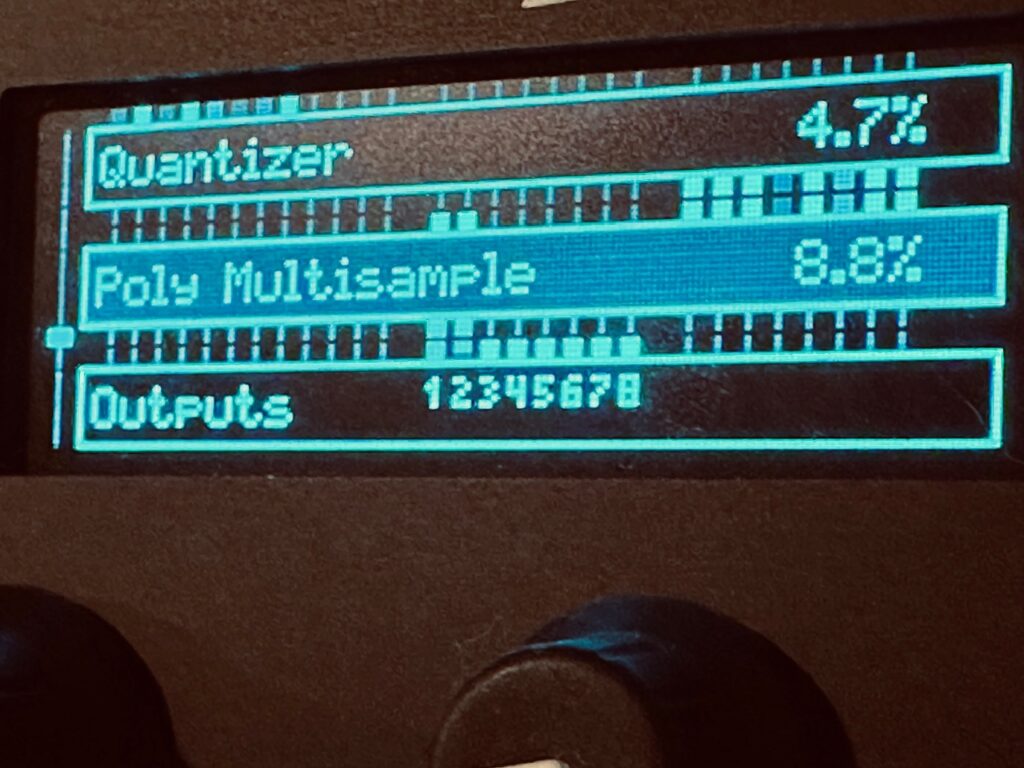
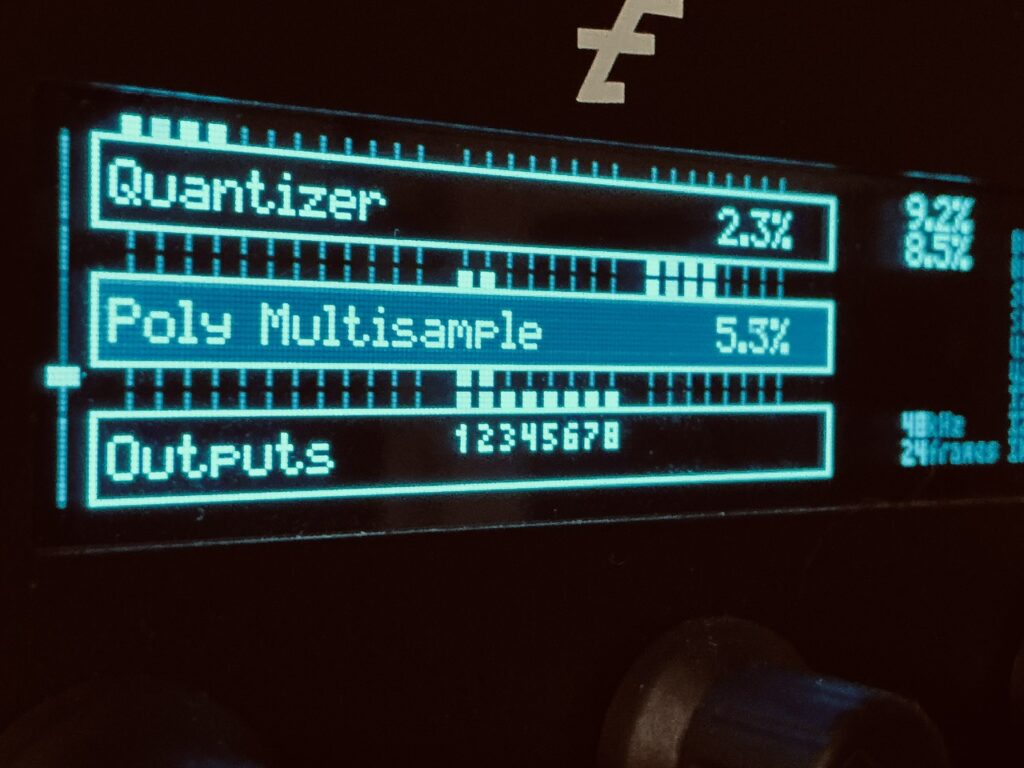
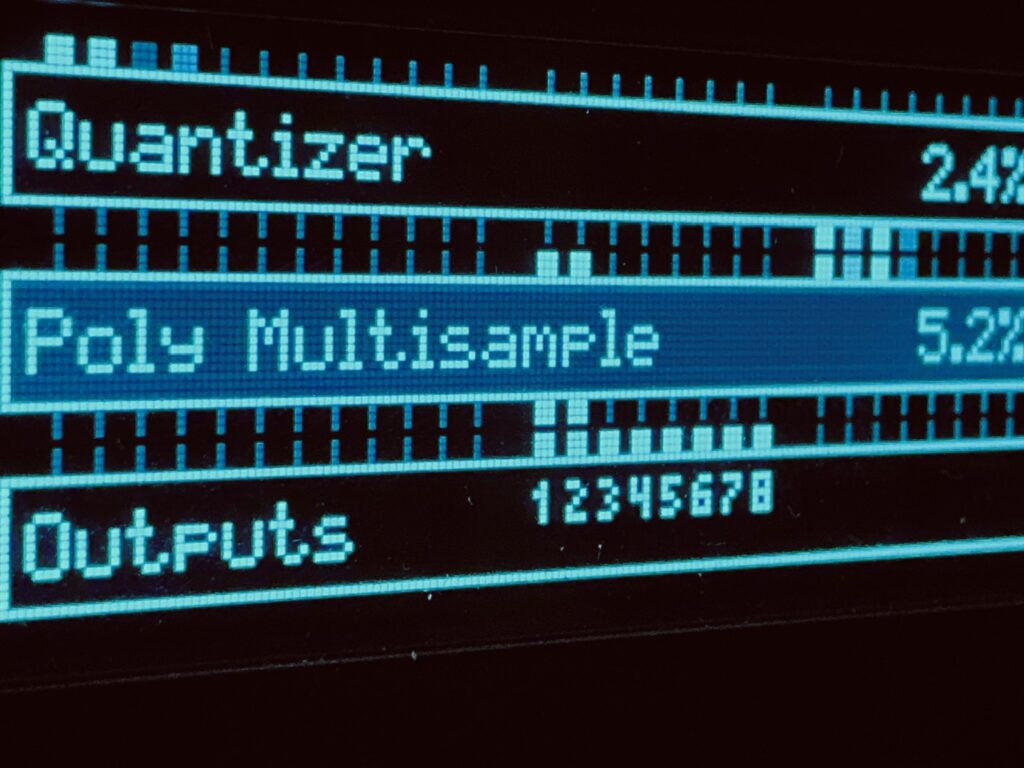
To add accompaniment while keeping to my desire to remain “home” I went with a tried and true technique of using chaos to control the Soft Piano samples in Disting NT’s Poly Multisample algorithm. I just don’t seem to ever tire of its sound and the additions it can make to a patch. To derive both the pitch and gates for the Soft Piano I used four outputs from the Swell Physics-controlled How’s The Serenity?. The first set of copies went to the always playful Nonlinearcircuits Numberwang which spat out gates used to trigger the samples, while the second set went to the ever useful Let’s Splosh, with four of its outputs, via separate offset and attenuation levels from the Vostok Instruments Asset, controlling pitch. This technique of using the same signals to create both gates and pitch values has been pure gold for me for a long time. I’ve used it in many patches, and will use it in many more to come. This particular sub-patch has become a core of my practice. It’s part of my sound. It’s home. Its ability to be a pattern until some change happens organically is intoxicating to me.
Although Soft Piano didn’t need any effects outside of the lush reverb I was using, I wanted to try an experiment. In one of my favorite patches that I’ve made this year I used my Make Noise system, exploring Echophon and its pitch shifting feedback path. Although I don’t have an Echophon in my main synth, I do have the ever-pleasant Holocene Electronics Non-Linear Memory Machine. I’ve used it to pitch shift before, but almost always in octaves, and almost always only when the buffer was frozen to create glitchy, granular-like sounds. I’ve never tried to pitch-shift repeats with it in the sort of way where repeats cascade upwards to help create the melodic flow. Oftentimes that sort of action can become a mess of ear drum piercing repeats quickly. The sort of sound that makes you say “Ooh, no…” before pivoting to something else. But during Sketch 23 I learned that not only can pitch shifting delay be done tastefully, it can also be done beautifully. With that thought in mind, I switched the pitch of the repeats to a perfect fifth, and used a slower delay time than I might have otherwise used.2 In addition to adding in cascading, pitch shifting delay, I also decided to use the frozen buffer to create that glitchy, granular-like sound. Using the 1<2 gate output of Swell Physics, via a VCA controlled by a clock divider, the Freeze function would start and stop, while one of the outputs from How’s The Serenity? scrubbed the buffer. The effect was distinct and pretty much what I was going for, even if the execution was less than I’d hoped. The volume of the delay was way too loud during these parts, and sometimes the length of time the buffer was frozen was just too long. But despite the problems in the final recording, this addition was a key part of the piece, and provided a solid proof of concept for future use. But I still wasn’t satisfied
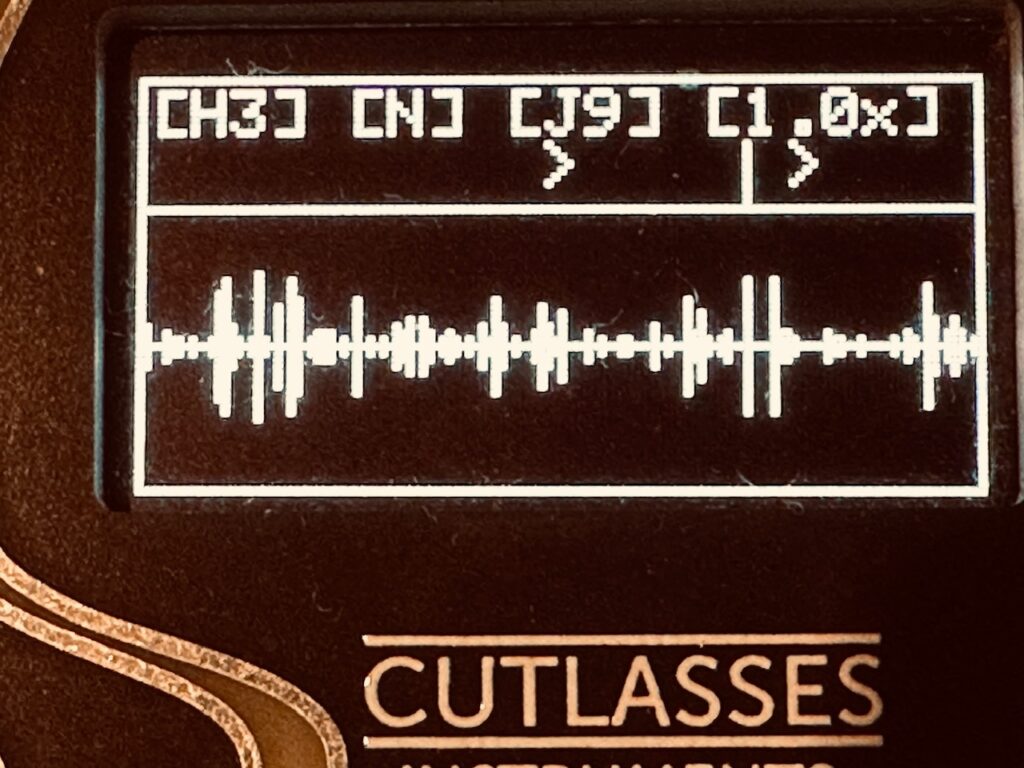
Another module that has become a centerpiece in my practice is the Cutlasses Instruments Gloop. I’m not sure how this module hasn’t absolutely blown up. It’s highly capable, and unique for modular loopers. At one point during the performance I hit the record button on Gloop and filled its buffer with nothing but dry Soft Piano. Normally I’d work up all four playback heads in interesting loops at various speeds, but for this patch, just two would suffice. The first playback head was set to play back at 1x; the second at 0.5x.3 Starting at about the 5:30 mark I began to manually crossfade the Soft Piano + pitch shifted delay out while bringing in the recorded Soft Piano on Gloop. At first it was only the playback head at 1x, but soon thereafter I slowly started to introduce the 0.5x playback head for a second layer of Soft Piano. Over the next several minutes I manipulated the playback areas of each head until I had two short(er) loops, which played out as they slowly degraded for several minutes until the piece ended. I’m not sure I’ll ever tire of this particular technique, even if the degradation sometimes occurs too slowly.
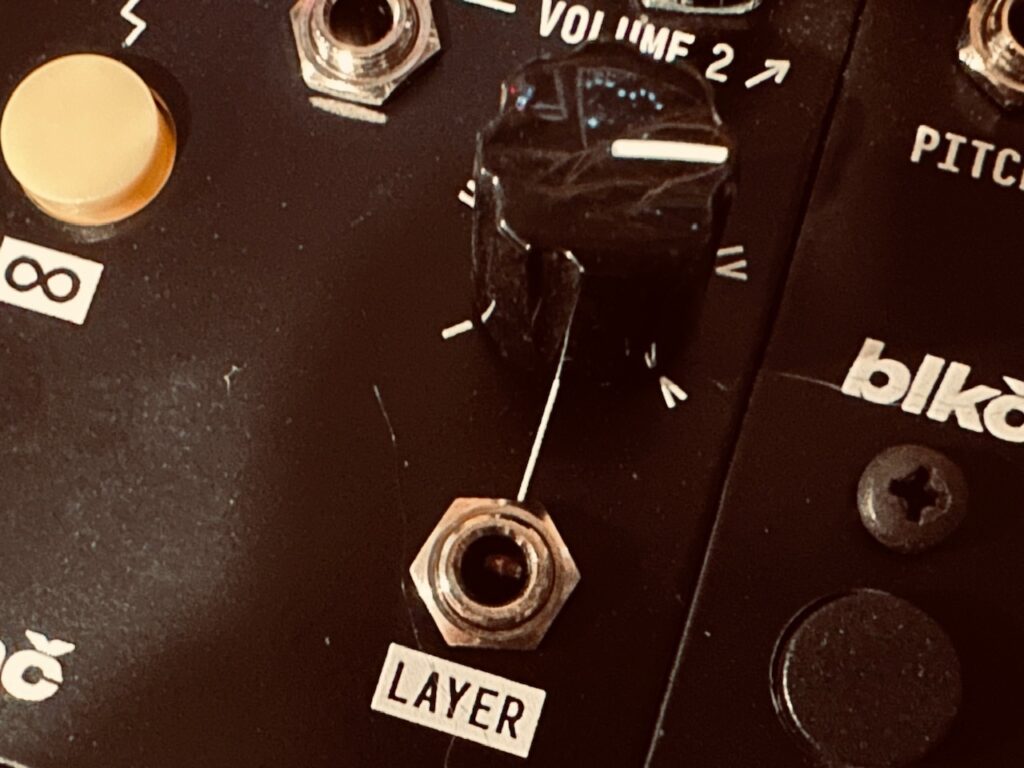
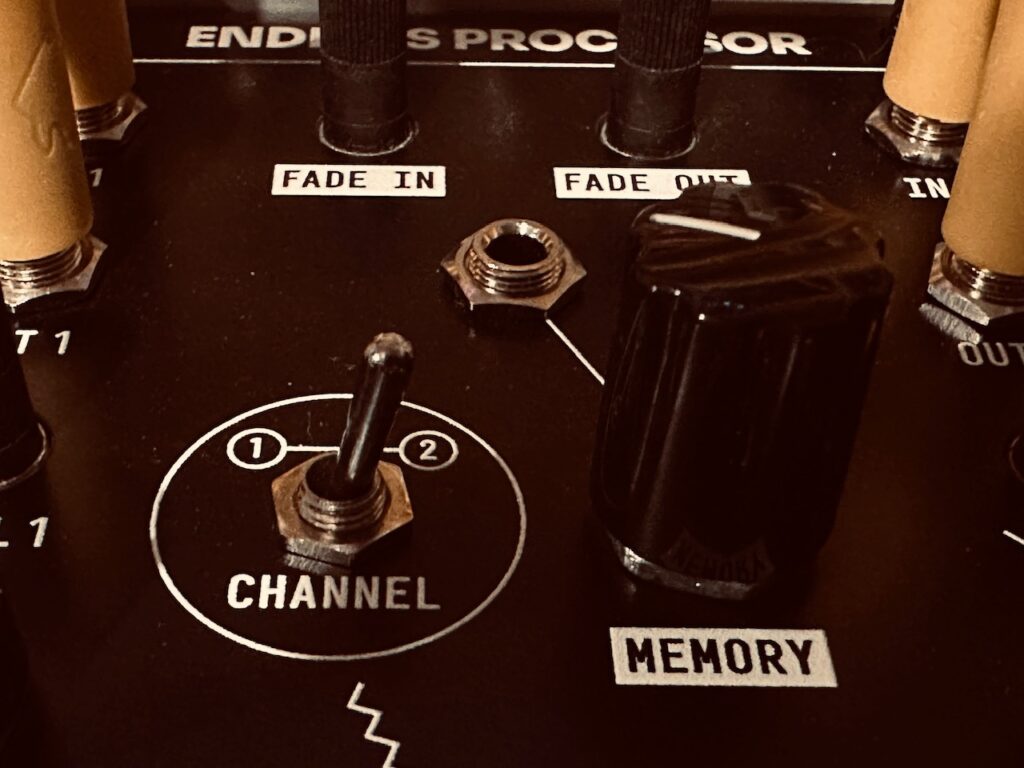
Although my intent with this patch was to remain fairly simple, using techniques that I feel are home base for me, I did want to experiment with a module I’ve had for a long time, but have drastically underused. For better or worse, I’ll (too) often hear a module that I’m positive will enhance my practice, buy it, then allow it to remain idle. Most of the time I’ll sell a module after a few months of non or underuse. But the Blukač Endless Processor has managed to stick around for quite a while despite my never having used it much. I even brought it as part of a very small synth setup on a trip last year, yet still managed to not use it. I’m not sure why I felt so strongly that I needed to keep it these last couple of years, but I’m glad I did. I’ve always imagined the potential I knew it had after hearing those first initial demo videos around its release.
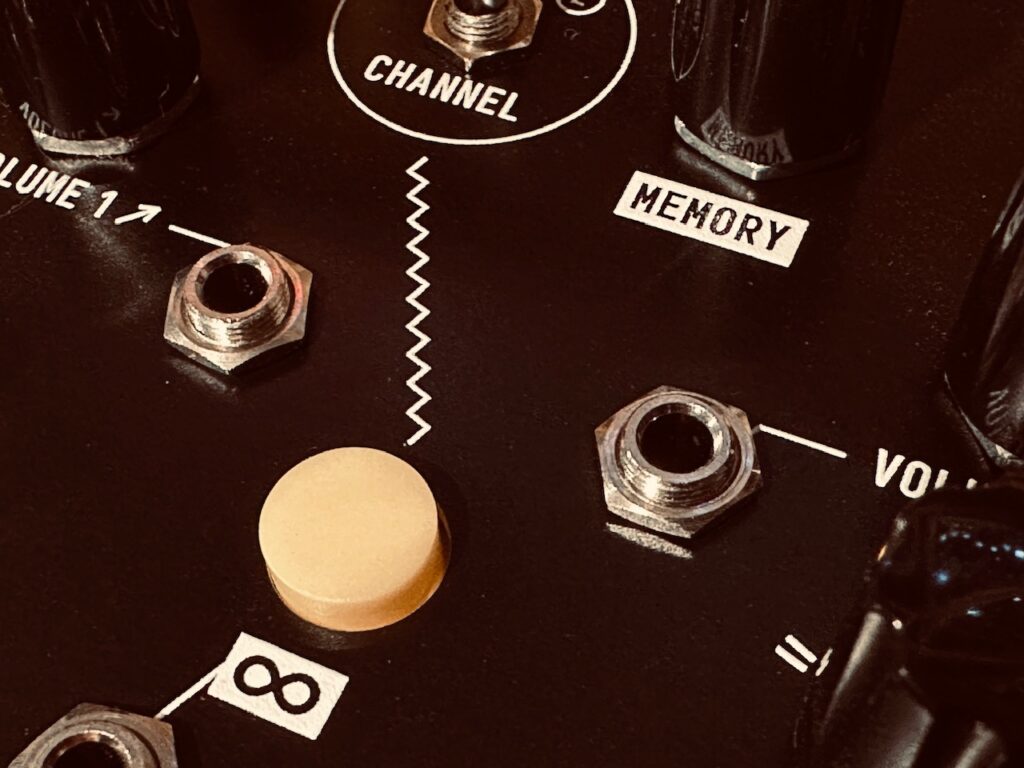
For me, this part was put together using nothing but raw intuition. There were no set points at which I’d fill a layer. I simply hit the Infinity button to record on a layer (both sides) when I heard a reverb tail I liked. I had no real way to verify its usefulness before it would be played as part of the performance. I had to simply trust my gut that what I’d heard was worth repeating, and that each of the five layers would work well together. Fortunately, my faith and perhaps a bit of dumb luck proved my decision to hang onto it fortuitous. As I began to fade out the sets of waves around the 4:30 mark in the recording, I faded in the Endless Processor, which acted as the main support for the Glooped Soft Piano. A soft bed of 5 different reimagined spectral reproductions of the reverb tail at various points of the performance up until that point. As the performance progressed, I slowly cleared one layer at a time until none were left at around 9:20 mark, and all that remained was the looping piano.
As per usual, Reverb is the mighty Walrus Audio Slöer in Dark mode.
I had a lot of fun with this patch. It was just what I needed to feel once again at home.
Most associate additive synthesis as starting with a sine as the fundamental frequency, then adding in more harmonics via frequency or phase modulation, or by adding sine waves of various upper harmonics of that original sine to create brighter timbres. ↩︎
After having listened to the track many times, I probably should have used a faster delay time. The shifting is nice, but is a bit slow. ↩︎
As Hainbach is fond of reminding us, “Half speed is the best speed.” ↩︎
It’s been a goodly while since I’ve created and recorded a patch. I recently started a new job, and, frankly, it’s doing its best to kick my ass. Even after the honeymoon period, I’m very much enjoying my new occupation. I generally like the people I work with, and, though hard on my feet, I like the work. But even still, as one might expect, its leaves far less time for creating music. About a month ago I ran into a recording on Reddit by OrbitalPatterns called “Right Street, Wrong Timeline” that captivated me. Although my initial interest in that patch was almost exclusively with the Glitch Cloud Audio Haze, I came to really appreciate each part of the piece. The simple-seeming sequence, delay, Haze, how he was using Mimeophon, the overall minimalism of the piece, and loads of other particularities, all goaded me into my Notability “Patches” notebook to ponder things. How was the sequence structured? How is he using Haze? How is he using Mimeophon? Can I take a similar path?
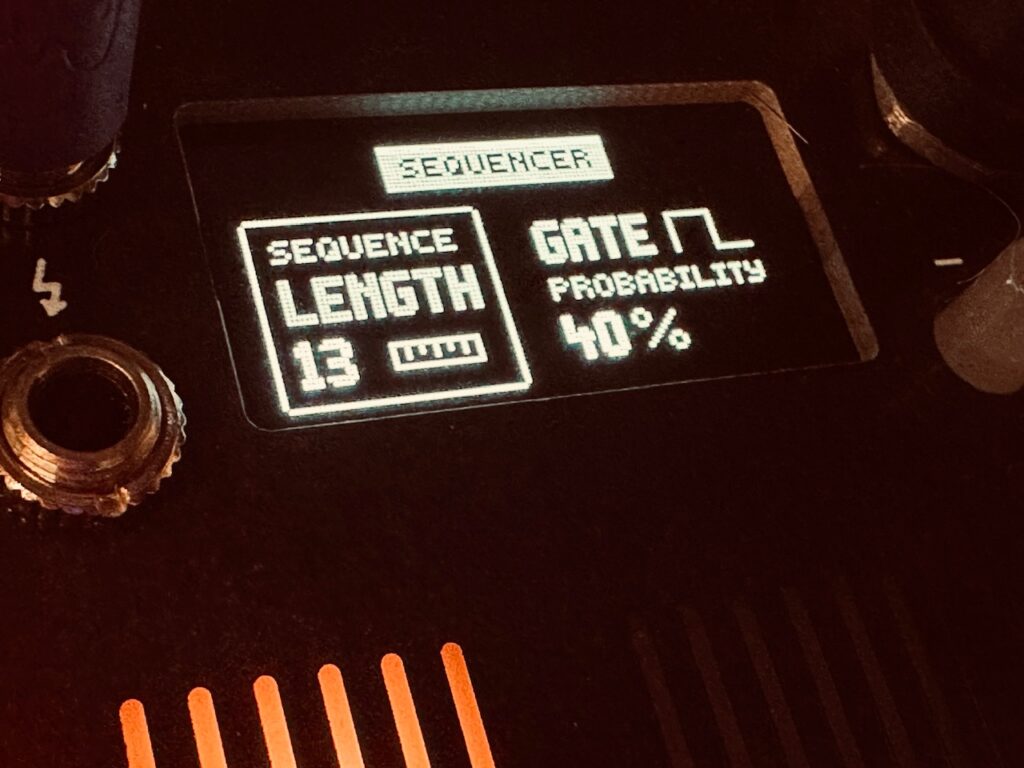
Firstly, although there is a very minimalistic quality to the sequence, it is not simple. It’s comprised of 13 steps, with each active step having variable levels of both gate and pitch shifting probability. Haze is very different from what I thought it might be. He heavily modulated the Zones on Mimeophon parameter to range between fairly long repeats and looper length delays. Although I certainly had no compunction to copy the piece, and simply copying the patch would sound far different anyways, I did want to explore similar techniques.
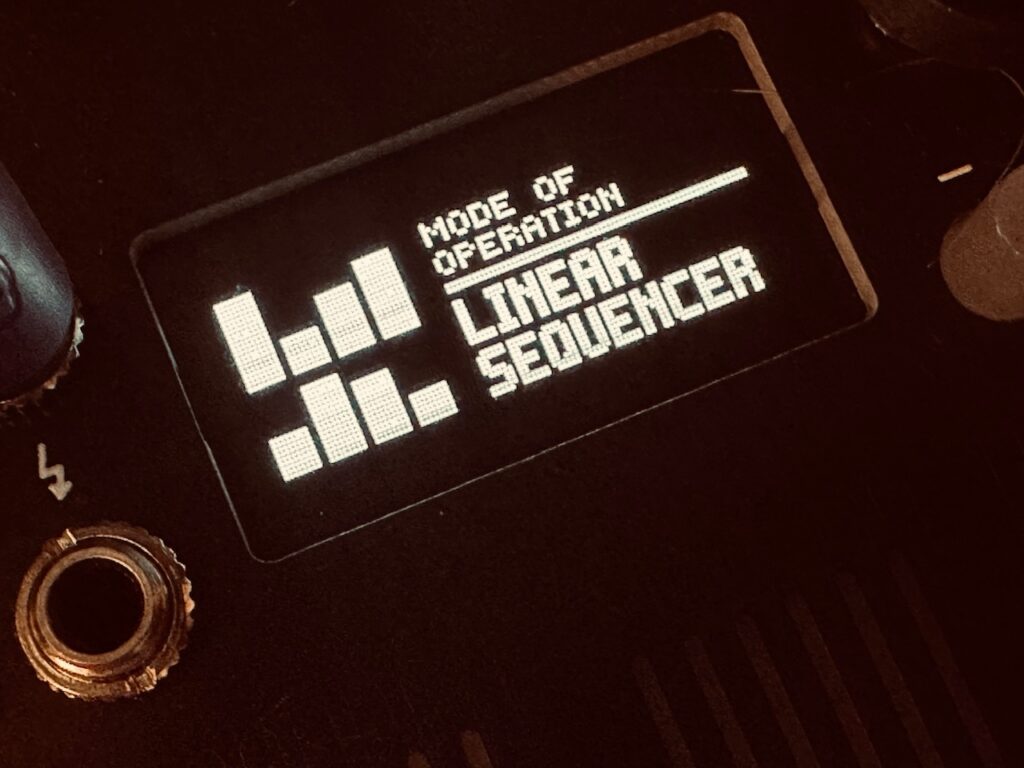
The patch starts out with an approximated sequence which was structurally very similar to the one used by OrbitalPatterns. A few years back in a patch from scratch video Innesti, an ambient artist that I’ve long admired, noted that sequences aren’t used often enough in ambient music. Although I personally use sequences fairly regularly in my practice,1 I tend to agree with his assessment. The original sequence in OrbitalPatterns’ patch was 13 steps, with seven of them being active (steps 2, 5, 6, 9, 11, 12, and 13), and I stayed true to that in my iteration, though I used different pitches. His sequence was generated and initially processed by a monome norns script, but I don’t have one of those (anymore), so I opted to use the very excellent Doboz T12 in Linear Sequencer mode to create the sequence for this iteration. Most often, I tend to disguise sequences a bit through Fading, but I wanted this one to be a little different. Although I most often use chaos-based techniques to manipulate a sequence, if not to control it outright, this patch called for something different. Rather than the regular-until-it-isn’t tendencies of chaos, I went with the far more used and unpredictable method of random probabilities. Although many sequencers can use random probabilities, few (in my meager sequencer collection)2 can do it as elegantly as the T12. One can easily and intuitively control both gate and pitch shifting probabilities globally per sequence, or per step. Although it’s impossible to discern what probabilities were used in the original patch, I used a 40% probability that a gate would fire on a given active step, and a 30% probability that the pitch would shift up or down within seven quantized3 semi-tones (perfect fifth) of the defined note for that step. The sequence was designed to be sparse, but not barren, and to randomly change pitches often enough to provide for some variability, but not so much that there isn’t a discernible sequence in use.
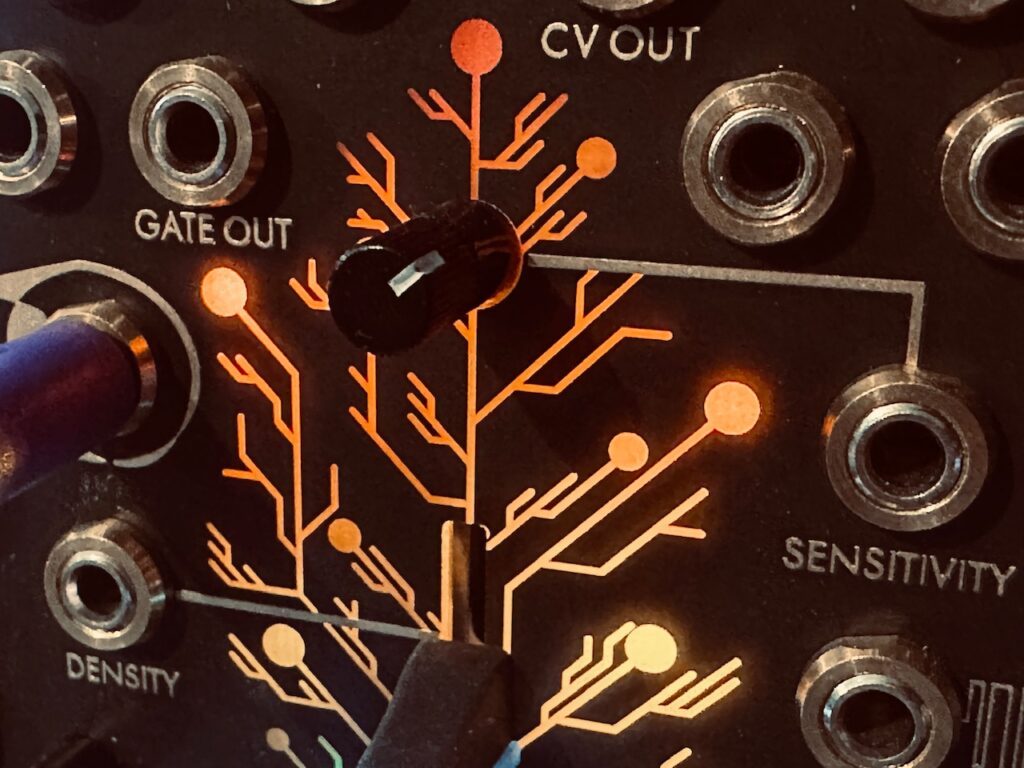
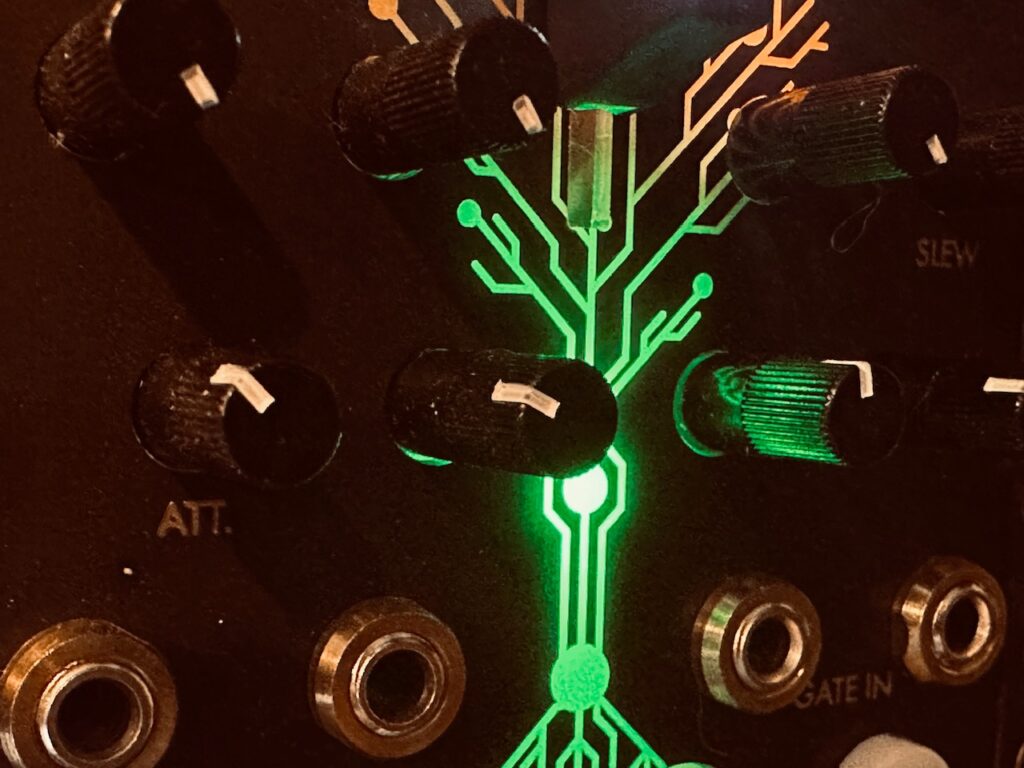
The sequence was sent to one of my favorite oscillators, the veritable Instruo Tš-L. Initially I used the sine output, and even though that was nice, it was missing an edge that I was hoping to achieve, and so switched to the Fold output. Not content with a statically folded wave, I opted to modulate the wavefolding using the ever-lovely Instruo Scion. Not only is the Scion one of the most beautiful modules in all of Eurorack, it’s also one of the most interesting. Though Scion is designed to be connected to a living organism like a plant or person via wired electrodes, the input can be lots of things, including noise. Having connected the input to the OG Instruo Tagh’s4 white noise output, its tree came to life, along with all of its outputs; lights flashing and random voltages for days. Cranking the slew parameters to fully clockwise as a means to create a slow(er), meandering smooth random signal, two of Scion’s outputs, heavily attenuated, were patch programmed to its own Sensitivity and Density CV inputs to create a feedback loop of random goodness. I connected another of the outputs to Tš-L’s Wavefold CV input and adjusted the attenuation so that the folded output would continuously change, though quite subtly. Most of the notes had a muted sine-like quality, but occasionally a sharper, more harmonically rich note ripped through the soundstage to beautiful effect.
I really love the Tš-L. At just 6hp it’s small, but it packs in loads of more advanced features from FM to advanced forms of PWM, and of course a fairly robust system of wavefolding where both folding and bias can be easily controlled. I like the Tš-L so much that I opted to double up on them in my Instruo case in lieu of purchasing one of their larger, more advanced oscillators like the Cš-L. It just does so many things well, sounds great, and is a perfect oscillator for a travel case.
Tš-L’s Fold output was patched to the legendary Rabid Elephant Natural gate for some sublime low pass gating. It should be clear by now that I really dig LPGs. To my ears they set the standard for how enveloping audio should sound. Although I often use a VCA for slowly controlling sound levels, I overwhelmingly prefer the soft bounce of a LPG to the perceived harshness of a VCA when using quick envelopes or via pinging. My initial intent with this patch was to use the Endorphin.es Furthrrrr Generator matched with the new Tokyo Tape Music Center Tokyo Gate 2, but that case wasn’t patched into Subsystems at the time, and switching that case in wasn’t in the cards today. Natural Gate doesn’t really need an intro. By this point, nearly a decade after it was introduced to the Eurorack world, it’s reached mythical levels of recognition. In short, Natural Gate sounds like a LPG should sound. Though only very lightly, I modulated the Decay, and used the envelope from the T12’s Aux output to the Control input while hitting the Hit input with T12’s gate.
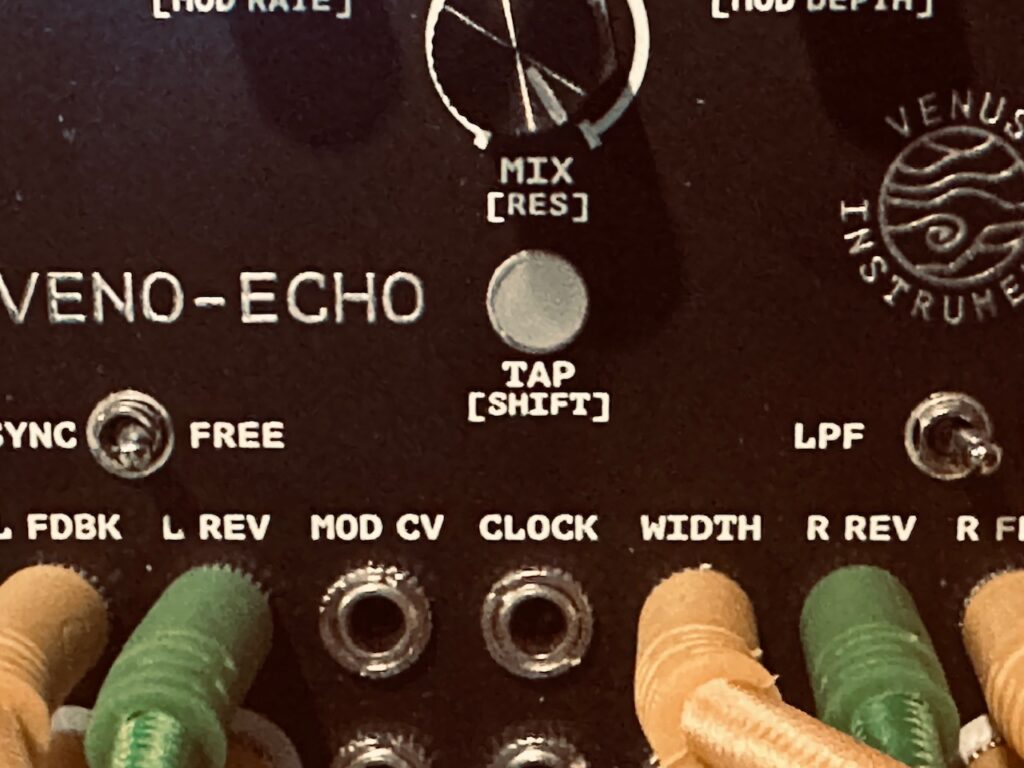
One aspect of the original OrbitalPatterns patch was that the delay on the sequenced notes is very basic. It’s a simple quarter note delay at about 92 BPM, and sounds quite pristine to my ears. I’m not certain, but I’m pretty sure the sequence, note generation, and delay were all a result of the norms script. Since I’m using modular synthesis rather than a fixed architecture script, I opted to try a technique I haven’t used for a long while. I learned this technique from the venerable DivKid in a video about one of his collaborative modules, Stereo Strip, in which he slowly pans the audio between two separate delays in order to get two very different effects. Although I didn’t use Stereo Strip in this patch, I patched a panner together using a VCA, the very awesome Intellijel Amps, and a triangle wave from the Xaoc Devices Zadar. These separate outputs were sent to both the oft-used (and my favorite Eurorack delay) Venus Instruments Veno-Echo, as well as a new(er) addition to my pedal collection, the Old Blood Noise Endeavors Bathing. The trick with this technique is using two delays with very different characteristics. If the output is too similar, the effect is muted, at best, or lost completely. In order to create a maximum difference, I opted to use the Veno-Echo is Reverse mode for both channels, though it oftentimes seemed to get lost. I’m not sure if the Reverse buffer was set too long, or else whether there just weren’t enough notes going to that delay to be more pronounced, but although I do hear those reverse swells, they aren’t nearly as prominent as the multi-tap repeats from Bathing, which is a bit of a shame..
Bathing is fairly new to me. It’s a stereo successor to an earlier pedal called Dweller, which places a delay circuit within a phaser. It’s quite unique, though I’ll fully admit I don’t quite fully understand how to use it yet. The sound on this recording was basically run into by accident. The result is a multi-tap affair that pans in the stereo field similarly to a ping-pong delay. The repeats are lush and round, with a deep texture that helps it contrast with the sharp and clear reverse repeats from Veno-Echo. The outputs from each delay were mixed with the input in the very awesome Addac814 6×6 Stereo Matrix Mixer before being sent to the output mixer in AUM for further processing and output.
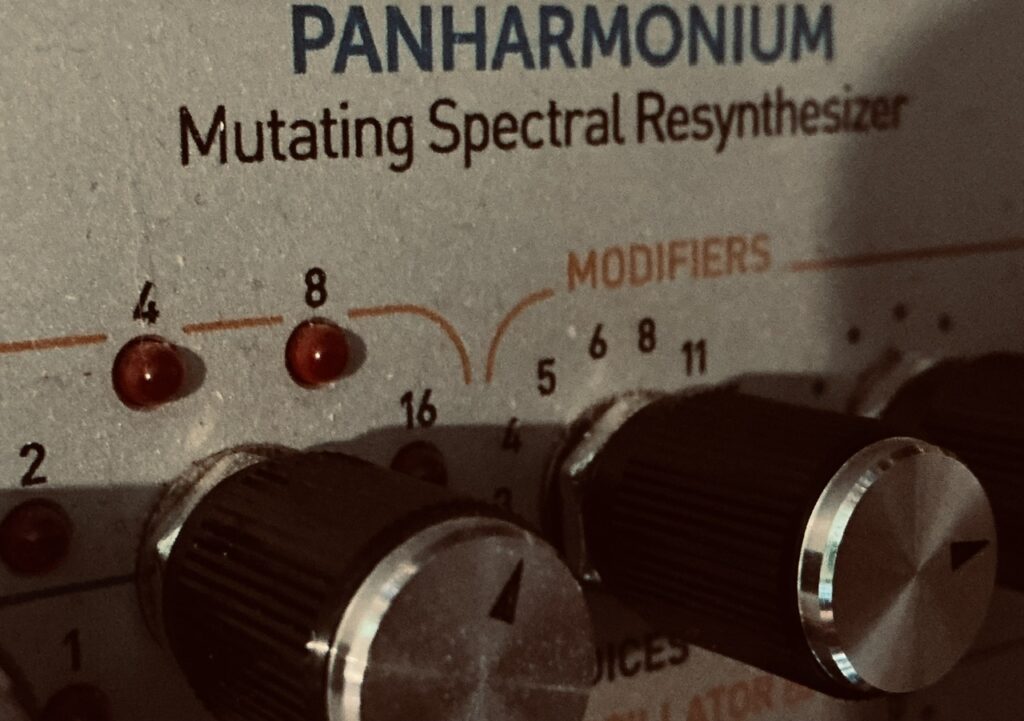
As a means to fill in a plethora of empty space, the mixed sequence and its differing repeats were also sent to the always lovely Rossum Electro-Music Panharmonium. Although the notes and their repeats were often present, there were times when the soundstage was simply too empty. The piece needed a proverbial sea for the notes to swim in. I’ve often used Panharmonium for this purpose. In fact, I use it for that reason most often. Although I’ve heard some wonderful Panharmonium patches, in my practice I’ve had the best results while using it in a more background role, acting as an almost ghostly accompanying choir for a more active sequence or melody line. In this role Panharmonium excels, and even if it’s not the focus of a particular patch, it’s still often the most beautiful part, and always plays an integral role. In this patch it roughly followed the sequence at one octave down. Because this patch was so sparse, I had to use more feedback than I’ve ever used with Panharmonium. Initially I tried to use the crossfaded saw outputs through a low pass filter, but I didn’t really like the sound. I was hoping to get a string orchestra sort of sound, but that’s not what I got at all. I tried several filters and the result was always less than what I hoped for. And although the switch to using sine waves was a drastic improvement, it wasn’t string orchestra either, even if it was much closer, with the result being a sort of mix between a choir and highly muted brass instruments in a sort-of flugelhorn register.
Panharmonium’s outputs were sent to the Holocene Electronics Non-Linear Memory Machine for some delay so that input might be lengthened a bit, before also being sent to the ever wonderful Pladask Elektrisk Dradd(s). Perhaps it was the nature of the input, but I didn’t get that stuttering, almost tremolo bowing effect I often get from the Dradd(s), although whatever effect it did apply was obviously missing when it was taken out of the mix, and succeeded in even further lengthening the Panharmonium into an aural apparition of sorts. It wasn’t a sound that I had initially targeted, but it was killer in its own very beautiful way.
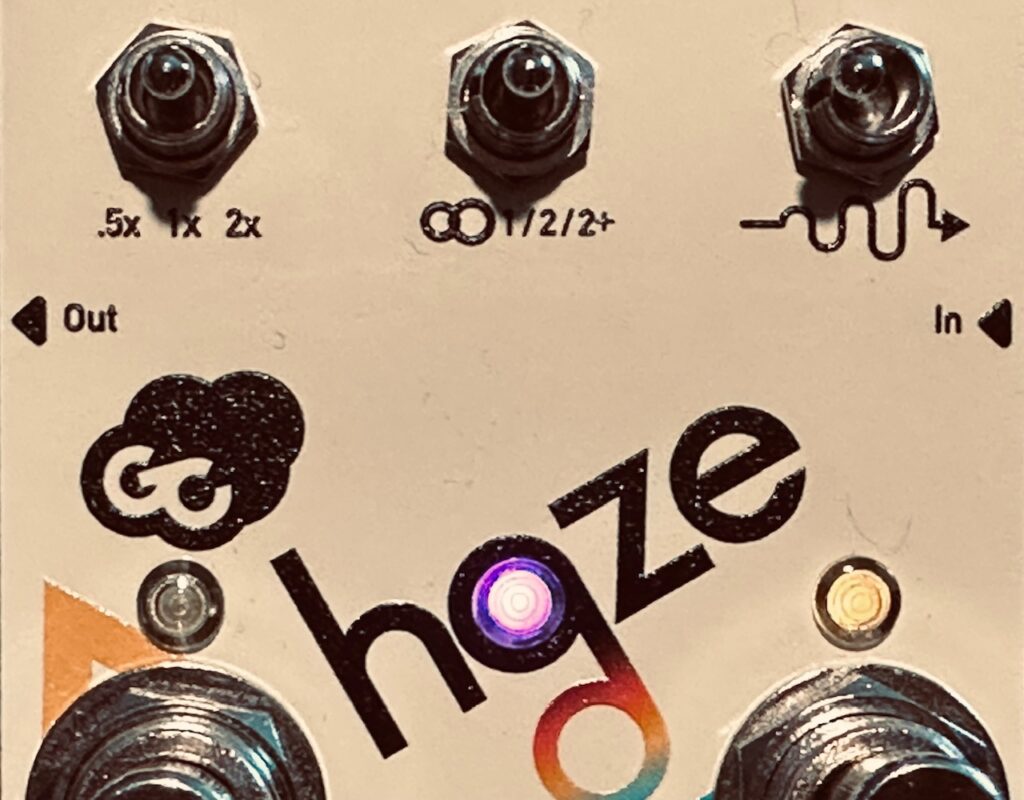
As mentioned earlier, Haze was very different than I thought it would be. I’m not exactly sure what I expected; perhaps some mix between the Chase Bliss Audio Mood MkII and the Mutable Instruments Beads. It is kinda sorta reminiscent of Mood in that it can loop samples in its own unique way, but being that it processes live input, as opposed to having to prerecord audio to a buffer, the result is altogether different. Although one can lo-fi audio with Mood using its Clock parameter, old school, digital lo-fi is part of Haze’s DNA. Not only can it jangle up your audio, it’s part of its essential character. Various forms of digital noise, bit and sample reduction, skips in the buffer, sundry clicks as the buffer repeats or the playhead is passed by the recording head, all contribute to a very dirty output, in the best of ways. In addition to its dirty digital lo-fi character, it also has a switch to introduce analogue forms of entropy as well. Tape skips, dirty tape, old tape, etc are all available, though I didn’t use them in this patch.
Although I didn’t really get what I initially anticipated from Haze, I really dug what it did give me. It was easy to dial in, and manually modulating the Time, Repeat, Haze, and Mod parameters all generated unexpected yet really nice results. Although it’s not really an effect I’d want to use all the time, it’s just about perfect when lo-fi digital fuckery is what you’re after. I still need more time to evaluate it, but Haze is definitely in the running to be a keeper. In this patch, I sent the mixed sequence and its duo of delays, as well as the Panharmonium and its effect chain to Haze. The result was a jittery, dirty pair of loops, one in each channel, of differing lengths (depending on the position of the Time and Mod parameters) that jumped about in Time in ways that were intoxicating. It certainly added intrigue to the patch in a way that heightened it as a whole.
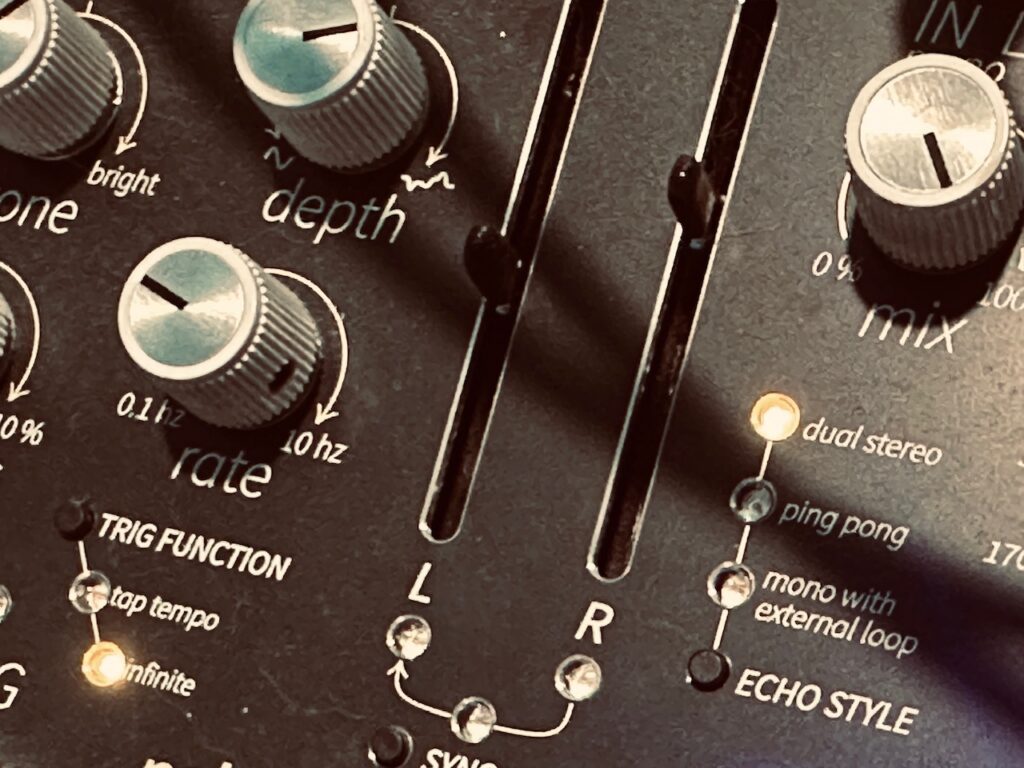
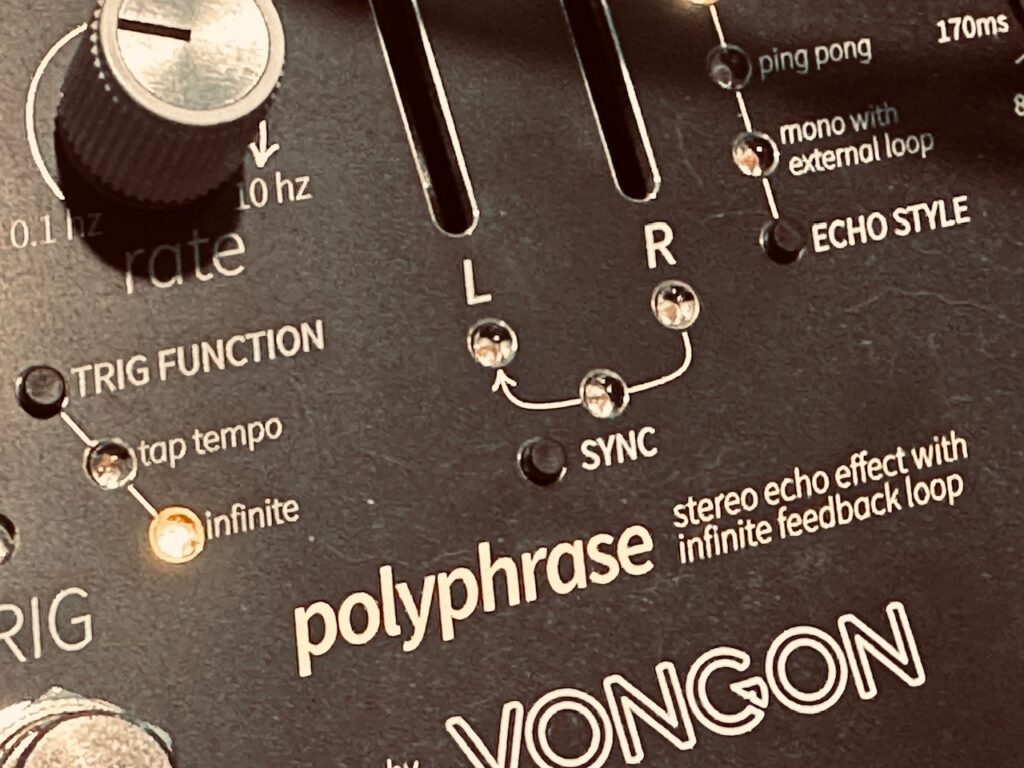
But I wasn’t done. In the original patch, OrbitalPatterns used a heavily modulated Make Noise Mimeophon to process the main sequence. The output of the sequence and its Hazed-up audio were processed through Mimeophon while being modulated between long-ish repeats up to very long looper length delays, which created a soup of delays that was incredibly interesting. While Mimeophon can be delayed up to about 45 seconds in the longest zone, I don’t have a delay (in the main synth) that has a delay time that long. I considered using the Veno-Echo in this role, as it can kinda get close, but since it was already in use I opted to go with the ever wonderful Vongon Polyphrase. Polyphrase is an incredibly flexible delay, even if it goes criminally underused in my practice. It has a maximum delay time of 22 seconds, with each channel’s time being controlled separately. The delay can be modulated, but since it only takes MIDI I decided not to open that particular can of worms and left it unmodulated, acting as a duo of time-separated loopers. The entire mix of the sequence and its delays, Panharmonium, and Haze was sent to the Polyphrase, with repeats turned up moderately high so that there would be several repeats of the input. After bringing in the Polyphrase output, I slowly faded out the rest of the tracks, allowing Polyphrase to to continue its loops until they slowly faded away and the buffer was exhausted.
As per usual, I sent the entire mix out to the Walrus Audio Slöer for some reverb with a smidge of octave up.
Make Noise René Mk 2, Make Noise 0-CTRL, Frap Tools Usta, Xaoc Devices Moskwa/Ostankino II, Doboz Prizma II, Glasgow Synth Guild Oct-Tone, Verbos Voltage Multistage and Sequence Selector, and others that can be used as a sequencer like Mutable Instruments Stages and Joranalogue Audio Design Step 8, etc. ↩︎
The quantized scale in this piece was C Lydian, though, as with many, if not most, of my recordings I don’t really know what the oscillator was tuned at. ↩︎
Tágh is another one of eurorack’s most visually stunning modules. ↩︎
Using chaos and chaotic signals is the most compelling technique in Eurorack. I’d say it again for those in the back, but I don’t think I need to belabor the message up front. Let me back up briefly. I’m a huge fan of chaos. This isn’t a secret. No matter how often one might use chaos it always surprises in the best kinds of ways. Its unpredictable predictability can sometimes seem like magic. More regular than random, and more interesting than oscillating signals, chaos rides a line between the knowable and unknowable simultaneously. I’ve argued before that chaos is the lone signal in all of Eurorack that can truly surprise a listener. Regularly timed signals like LFOs and envelopes are, well, regular. There is no surprise when one knows exactly what should happen, and when it should do that thing. Random can’t surprise a listener because there can be no expectation. In order to be surprised you have to have some form of expectation that’s somehow subverted. Because random is truly random, there can be no expectations about what might be coming next, and so true surprise isn’t really possible. But chaos, because it’s mostly regular, although subject to the ephemera of everything surrounding it, has a habit of setting up expectations. It’ll be, or at least appear, regular until something happens. Maybe a different note plays than you were expecting, or perhaps it happened in a different place than it played previously; some change happens. And it’s in those changes, when expectation turns into surprise, that the potential for true magic awaits.
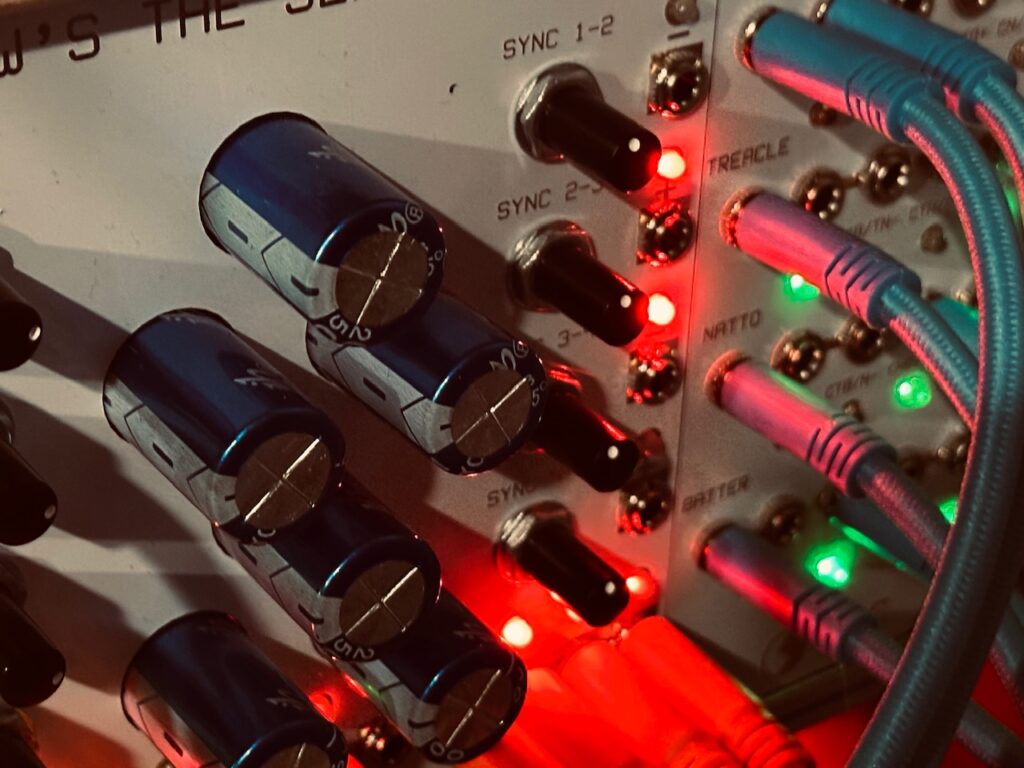
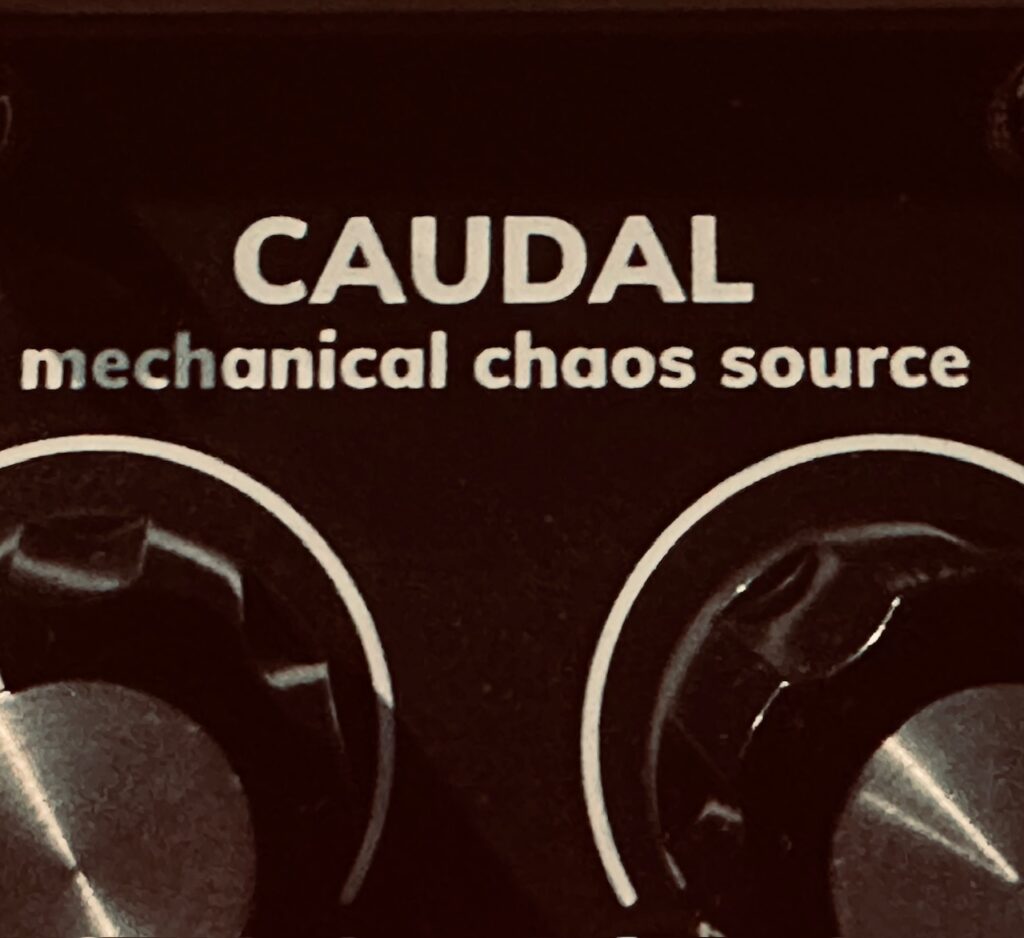
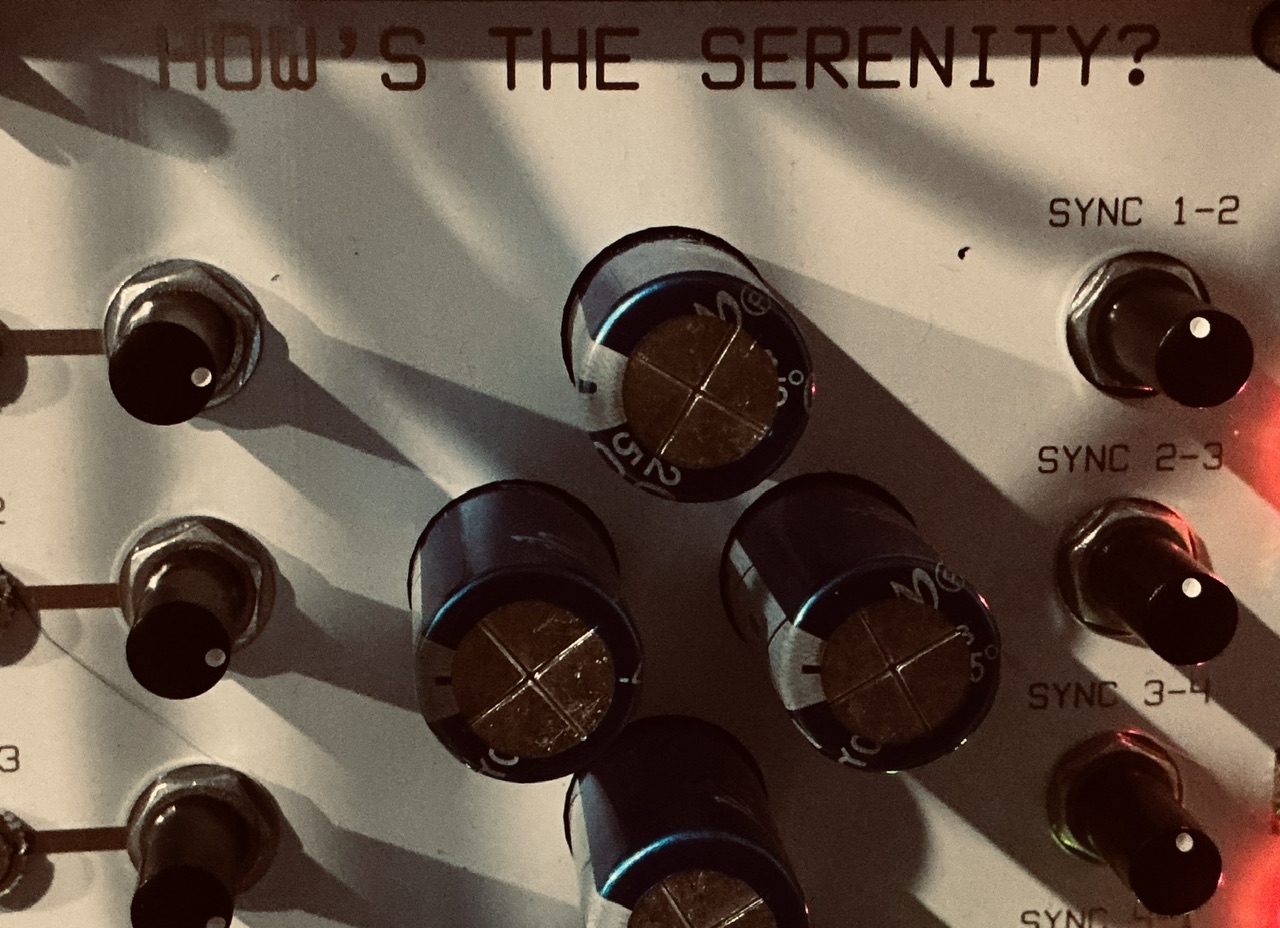
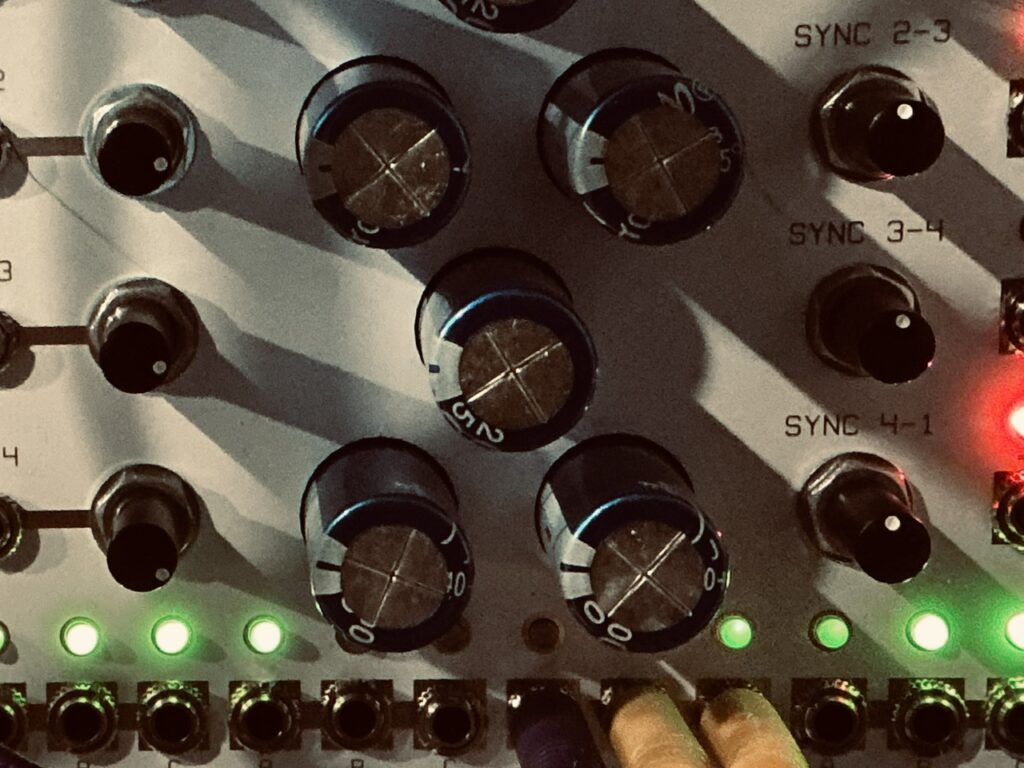
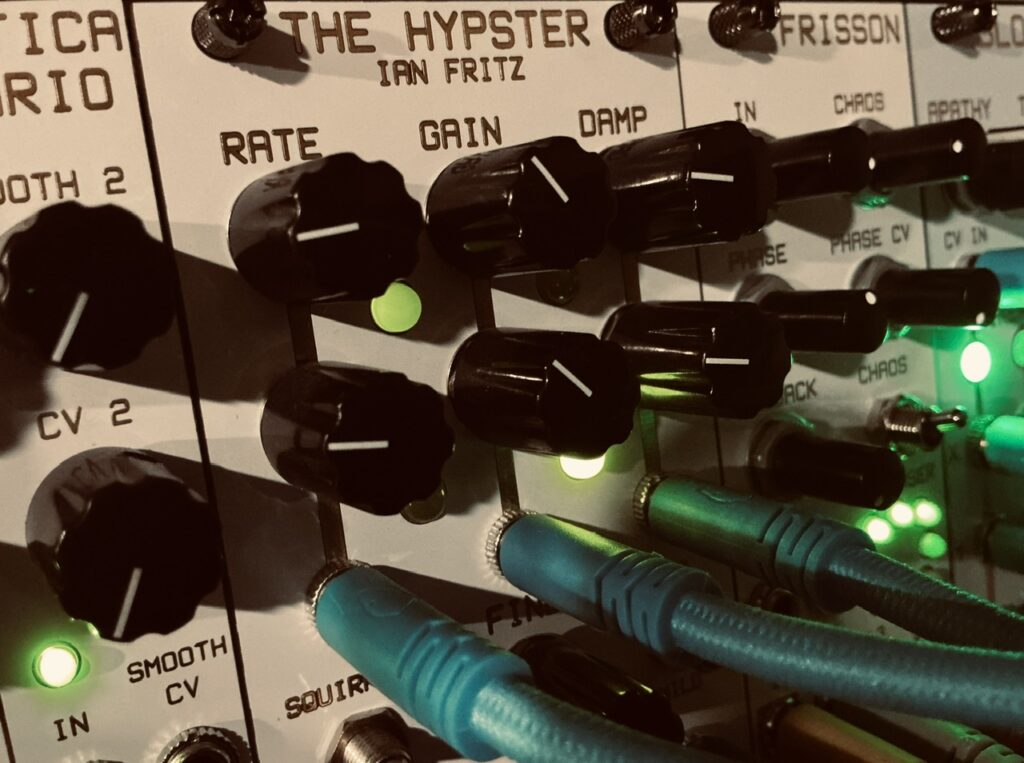
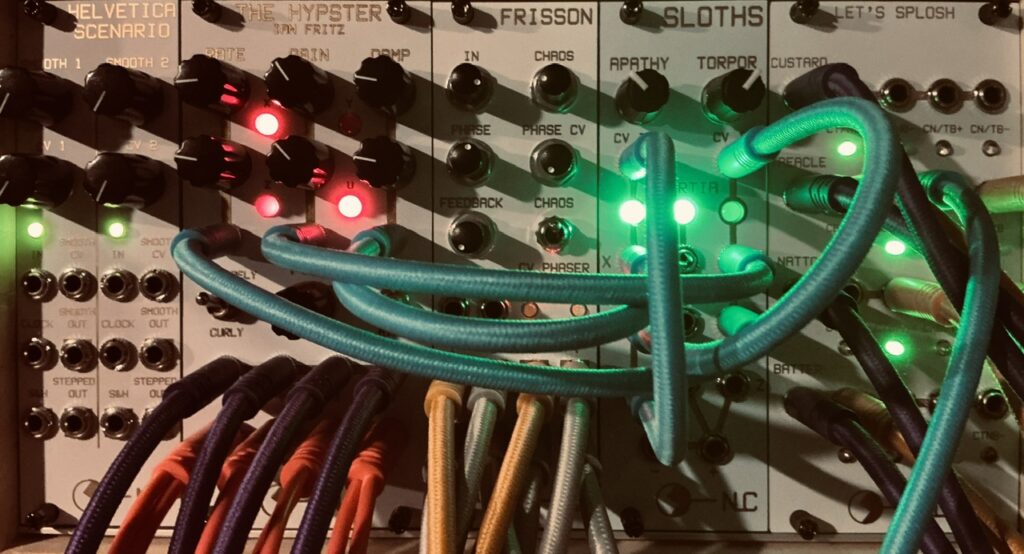
In my last patch I primarily used chaos from a new module I’ve recently purchased, the Nonlinearcircuits How’s The Serenity?. It’s a mega-sized chaos generator with some chonky blue capacitors. Each channel and group is somehow affected by the one before it, and it creates 12 separate streams of wonderfully irregular chaos at various speeds. It really is my kind of module. The sort that enables me to use various related signals, but that are also discrete. I’ve used various chaos sources to control whole patches. The Hypster, Frisson, the Addac508 Swell Physics, and more have all seen action as the conductor of the proverbial electronic orchestra. I’ve used them as direct sources, as well as indirectly through modules like the Nonlinearcircuits Let’s Splosh or the Atomosynth Transmon. Chaos is at the heart of almost every patch I create on the main synth (and increasingly on the Make Noise synth via chaos mode in the ever-wonderful Spectraphon). Using chaos is built into my composition ethos. But one source of chaos that I’ve had for a pretty long while, and a module that has its origins in VCV Rack, yet that I haven’t used very much, is the Vult Caudal.
Caudal is a chaos simulator that has several modes which model various nonlinear processes in the real world. Now sporting eight different models (though mine still has only the original four), Caudal was a module that I’d long been after. With infrequent, low number production runs, however, I found it more difficult to source than most modules I’ve hunted. They’re only intermittently available as new products, and it seems that few people ever sell it once they get one. Having been signed up for their email list for over a year, I finally received an “In Stock” email several months ago, and immediately pounced on one. But when I received Caudal a few days later, it kind of just sat there in the case for a while doing nothing. When I needed chaos, I opted for something from NLC, and, for whatever reason, just kind of ignored Caudal. After a while I finally decided to give it a shot, but quickly gave up, using it for no more than simple modulation of a single parameter. “I’ll just use The Hypster/Frisson/Triple Sloth” is what I’d say to myself. When I approached Subsystems today I knew that would change. In fact, by plan, it changed in a big way. By my count, Caudal controlled no fewer than 11 other modules comprising of even more different processes, affecting nearly every facet of the patch in some way.
Wholly dedicated to taming the Caudal, I immediately started with trying to find what mode I wanted to work with. Though I’m betting there was more than a bit of confirmation bias happening, I finally settled in on Fish Tank mode; one of the primary chaotic models that first caught my interest with Caudal. In the manual, Vult describes Fish Tank as,
The Fish Tank mode simulates four fish navigating within their tank in search of food. The movement patterns of the fish produce organic, meandering signals that are well suited for modulating parameters where natural-sounding variation is desired.
The model simulates the dynamics of the fish bodies navigating the water. Each fish has a small brain that makes simple decisions, like choosing a direction to search for food or avoiding other fish.
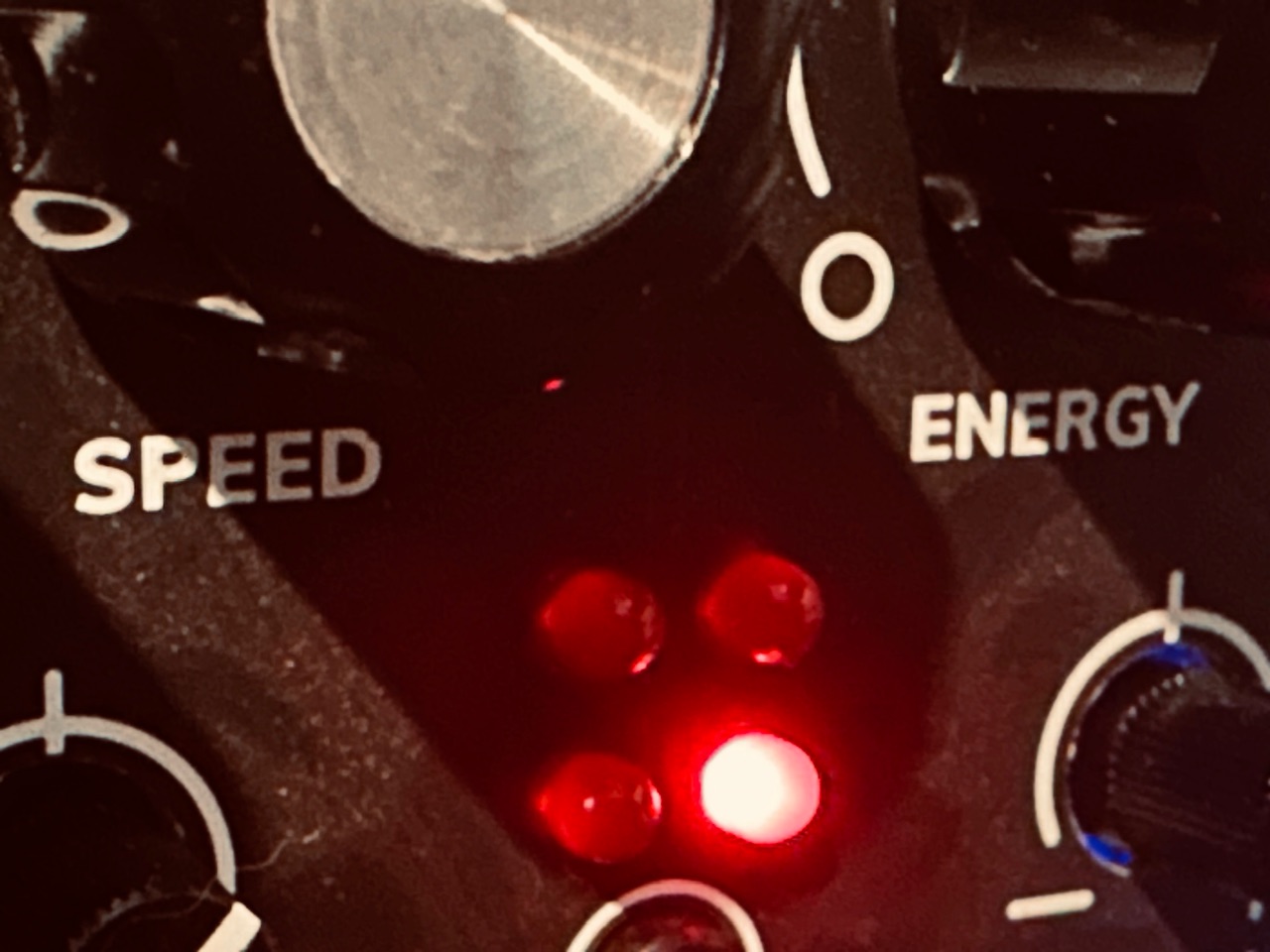
This sort of model is a microcosm of the beauty of chaos. Discrete signals all affecting and being affected by the others in real time. It took a goodly amount of time to hone in on some good settings for Speed and Energy. I wanted predominantly slow(er) movements with few abrupt changes, particularly in polarity. Speed is reasonably self explanatory, but Energy is, er, not. Without going into much detail, the manual describes Energy in Fish Tank mode simply as, “The energy parameter affects the fish’s decisions and makes them more eager. This makes their movement more chaotic.” That’s not much to go on, but it’s something. Though I may be wildly off, in my head I likened Energy to using Gain on NLC’s The Hypster. MOAR gain = MOAR chaos. Even if the process is different, that intuition proved fruitful. The further clockwise I’d go with the Energy knob, the more chaotic (read: irregular) the signal tended to be. Planets was also reasonably compelling as a source, but in this particular patch there were just too many abrupt changes for my liking.
Using slow waves to control the levels of various tones is a meat and potatoes patch for me, and it’s how this patch got off the ground. No matter how I approach these sorts of patches I’m nearly always dumbfounded at its beauty. Having made patches like this many times before with various sorts of CV sources from regular LFOs to stochastic functions, and indeed chaos, I quickly went to work. My first move in a patch like this is to get a whole lot of copies of the signals I want to use, so I patched the four X outputs of the Caudal to the Rides In The Storm QAM before patching each of the four signals to the CV inputs on channels 1, 3, 5, and 7 of my Intellijel Amps bank of eight mixing VCAs. These signals controlled the audio levels of four outputs from the Humble Audio Quad Operator, all being sine waves of different (sub)harmonics of F, as well as a noise signal that accompanied each of the four audio inputs. Although Quad Operator’s level can be controlled via its onboard VCAs, I opted to use external VCAs so that I could more efficiently use the same CV source with noise for both while mixing them together. I could have done that using any of several different techniques, but this seemed at the time to make for the most efficient patch; fewer cables and intermediary modules. This combination of noise and simple sine waves sounds at times like a choir, and at others like a French horn. Though this subpatch would generally be a fairly simple affair, it took a lot more fiddling than I imagined it should. Between getting the noise and audio balanced and mixed correctly for each individual channel, and then balancing each of the four audio/noise mixes together, it took a very long time to finally get a mix I was happy with, but with diligence and an ear eager to find the beauty in these sounds (along with some reverb to smooth out the edges), I found satisfaction. Sort of. Wanting some different sort of movement, I patched a mix of all four of Caudal’s X outputs, with a fair amount of both offset and attenuation via the very excellent Klavis Tweakers, which slowly moved the second highest harmonic up and down the harmonic series in a way that sounded almost like improvised flute. This shifting of harmonics doesn’t happen all of the time. In fact, for much of the patch the cable wasn’t even plugged in. But it also didn’t need to be continuous.
Though happy with the base sound of the patch, I wanted this bed to have a grit to it. The sounds should be beautiful, but beautiful doesn’t always equate with pristine. Despite being mixed with noise (courtesy of the Instruō Tagh, high pass filtered in the I-ō47), there was still a sense of clarity that was, to my mind, distracting. It needed an edge to it. Something to give the sound texture and depth. Often I would reach for a distortion module of one sort or another. The brilliant Malgorithm Mk2 or Bizarre Jezabel Mimosa would generally be first on the list of modules to try. But before patching those up I remembered a close friend reacting to one of my patches with one simple phrase. “Oooh! Crunchy.” Though Jamuary 2527 might have more audible repeats than I would otherwise like, it is the sort of sound I was after, and I knew just the module to provide it. Enter the Bizarre Jezabel Quarté Mk2.
Quarté isn’t what I’d call a regular part of my module rotation. It’s a very unique LPG/delay combination with a quad of PT2399 delays with a few tricks up its sleeves. Inputs can normal for getting multiple taps from a single source. It’s delay time and feedback can be pushed with an emphasis on its production of noisy repeats. In short, it can seemingly sound as if the edges of the audio have been singed, particularly as you get more and more repeats that progressively decay further and further. Rather than trying to be an everyday delay, Quarté unabashedly embraces its noisy inclinations. It has a voice of its own.
Although the input level going to Quarté was generally very low, due to each of the harmonics needing attenuated level control lest they break up in a manner I thought displeasurable, leading to a lower level of crunchiness than what I had originally hoped for, it did add some much needed texture. A grittiness that seemed as if one could reach out and touch the sound. The repeats also greatly lengthened out each of the individual harmonics gloriously so that they faded out more naturally. The sound was fattened by Quarté’s repeats, allowing it to fill up the space between and become full while simultaneously giving the sound a sense of vulnerability. These harmonics are the warm bed on which everything else laid, no matter how unstable it might seem.
With Quarté, Caudal also made an impact. Not content with simply repeating the bed of notes, I wanted to give at least the higher harmonics a sense of movement; an unsteadiness to add to the fragility of it all. Though it took a while to narrow in on the amount of attenuation, which turned out to be very heavy, I used two of the Y outputs from Caudal, via the Vostok Instruments Asset, in order to modulate the time of the two Quarté channels used on the two highest harmonics. This added a wobbliness to the sound in a somewhat similar way that using very light frequency modulation might. It doesn’t stick out as noticeable, but it is one of those facets of modular synthesis (and indeed music – art? – in general) where though one might not pick out a particular facet of a piece as obvious, it does tend to be noticed when it isn’t there.
All of the delayed and crunchified harmonics were then patched to the always useful ST Modular Sum Mix & Pan where they were mixed down to stereo. The bass note, an F2, was panned in the center, while each of the other three harmonics were moved around the stereo field by three triangle functions from the Addac506 Stochastic Function Generator. All three of those envelopes were stochastically created with each cycle. None of them were ever the same, which created a slow drift of sound back and forth across the soundstage. Though I’ve certainly used chaos to pan signals in stereo, I tend not to like the result nearly as much as using standard cycling triangle functions or LFOs. The movement is smoother, and encompasses the entire stereo field more evenly. Using chaos or random can be interesting, and can work better with more disjointed or rhythmic material, but most of the time, in my own practice, irregularly distributed signals are just not as good for panning.
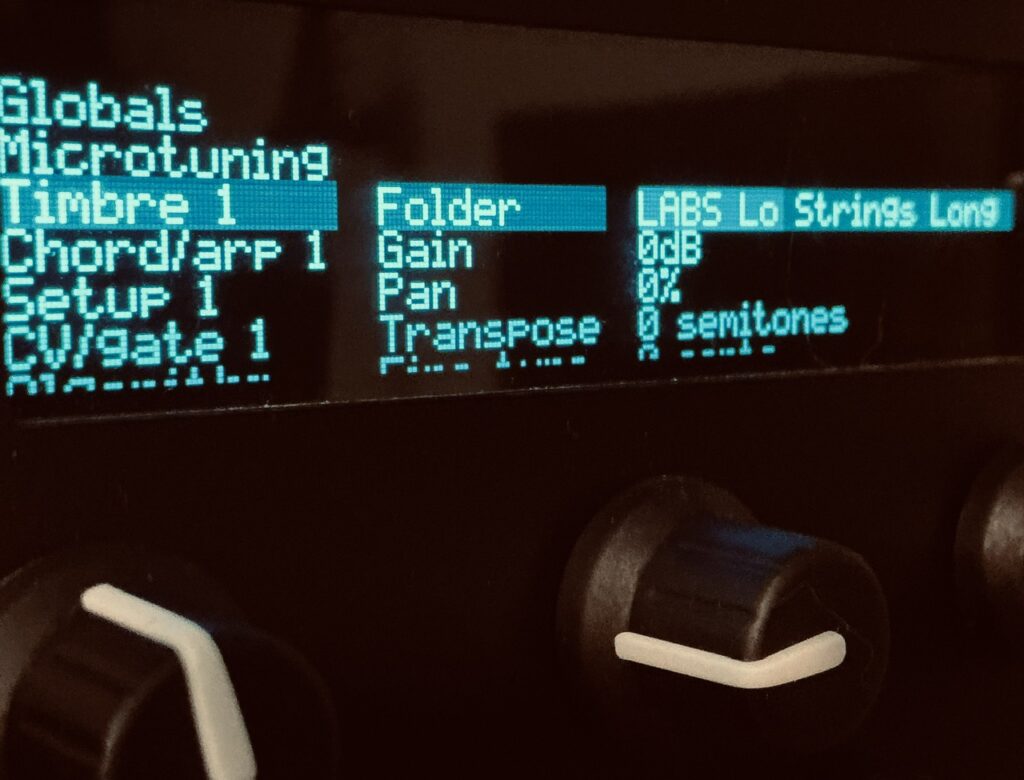
Having settled in on a bed of sound to,anchor the piece, I wanted to figure out a way to add to its depth without distracting from it. In most patches I would add in something like piano or a music box samples, but those are a sort of melody, and what I wanted was a buttressing of the existing bed in a way that was complimentary. As I thought about it for a while, I was suddenly smacked by the thought of using low strings. Not only would they establish the key (F Lydian) once a trigger hit the Disting NT’s Quantizer with just the right voltage coming in, but strings would also add a more organic texture to the overall presentation. I don’t use string samples nearly as often as I’d like, but today was a perfect time to explore the Spitfire Audio Labs Lo Strings set of samples.
Again Caudal’s X outputs took the lead in directing the Disting NT’s Poly Multisample algorithm by supplying four gates, via the Nonlinearcircuits Numberwang, as well as the voltage streams which determined what pitch to play when those gates hit. The four X outputs were patched both to the Numberwang as well as to the Disting NT’s (programmed) CV inputs. As Caudal’s signals moved about, Numberwang generated gates at its 16 outputs. With the help of a few Stackcables to combine two gates for each gate input on the Disting NT, eight of Numberwang’s gate outputs served to trigger the Quantizer that would quantize whatever was present at its CV inputs, and play that note as a discrete string sample. Because of the timbre differences between the highly processed sine waves that formed the initial bed of sound and the Lo Strings samples, the impact was both immediate and compelling. I initially thought that the two voices combined together might become muddy. They play in the same basic frequency range, and are enveloped in fairly similar ways, but this wasn’t the case at all. They complemented each other brilliantly, and the strings added a weight of seriousness to the piece.
Looking to texturize the sound, I patched the Lo Strings through the venerable Dradd(s) in Grain mode. This sub-patch has become a staple in a goodly chunk of my recordings. Because the Dradd(s) are a (set of) live processor(s), rather than audio needing to be pre-recorded to a buffer, they act as a almost granular delay in a way that I find intoxicating. Sound goes in whole, and comes out with granulated trails. I often liken the result to the wake of a boat, or the smoke of a fire streaming about as the solid material burns. It’s a greatly unstable sound, promoting images of decay and fragility in the most beautiful ways. I’ve often thought about getting a stereo Dradd, but, like Caudal, it too is only seldomly produced, and they sell out near instantly. Caudal also acted as the only modulator for the Dradd(s) as well, controlling P(arameter)1, causing the Dradd(s) to subtly change the the level of grain shuffling and randomization.
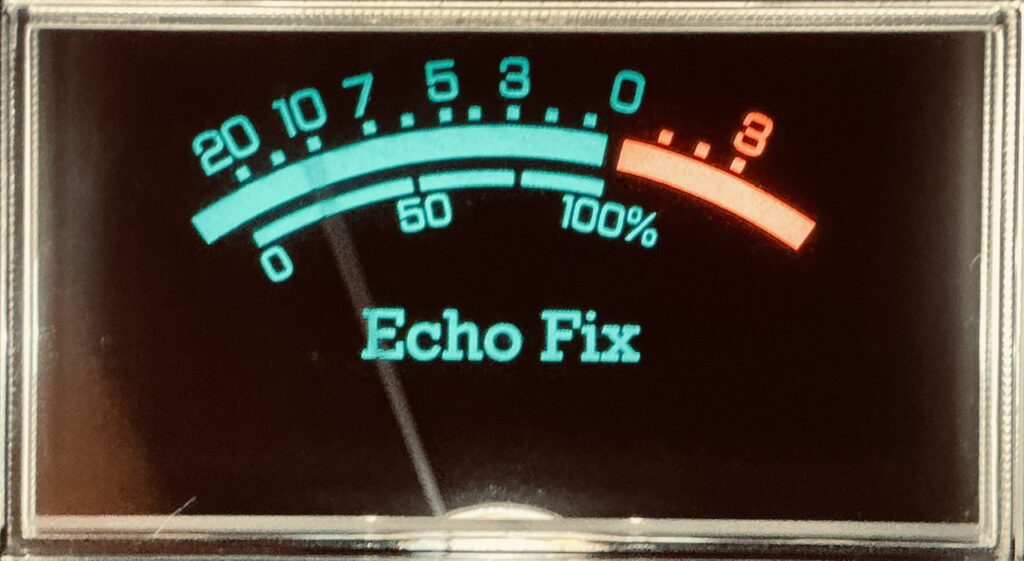
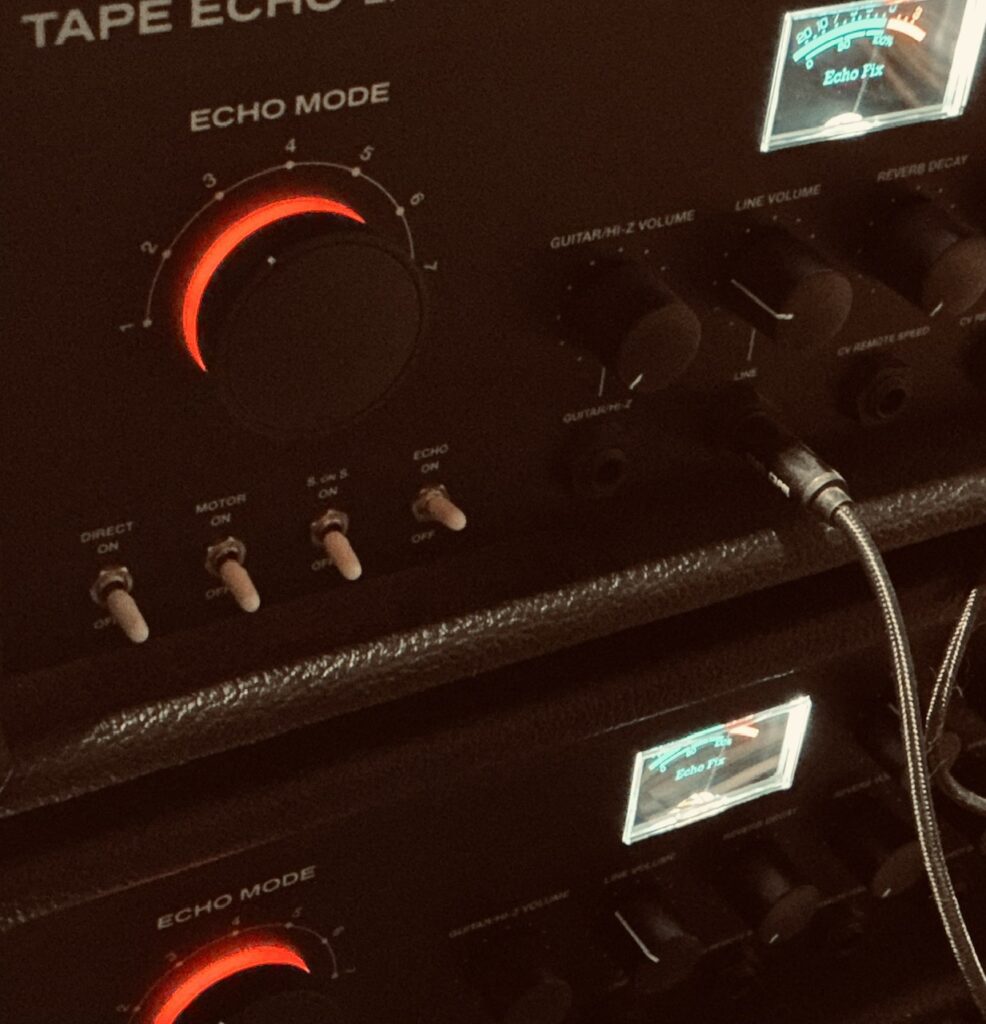
Once through the Dradd(s) the Lo Strings and their granulated trails were patched to a pair of Echofix EF-X2 tape delays, both for its wonderful tape magic, and also because of its superior preamp. Together they add the perfect amount of mojo to any sound. In this particular patch the tape echoes are used primarily to add length to the sounds going through them, along with a hefty dose of entropy to sweeten the pot and sense of fragility.
Once I had a proverbial orchestra laying an ever-shifting foundation built on frail bedrock I knew it was time for ornamentation. This piece didn’t really require a melody, but it did call out for a bit of playful flourish. Rather than resorting to samples, I decided to synthesize the sounds. My initial thought was to use primarily my Instruō Subsystem, but putting these short plucks through a standard VCA wasn’t satisfactory to me. I’ve long enjoyed Instruō, but I do not care for their solution for a LPG, Aradh. Being a button combo heavy affair, along with other aspects I consider shortcomings (like shared CV inputs) it’s just not at all the kind of module I find enjoyable to use. Had I the foresight to install my latest case rearrange, I would definitely have used my new set of Tokyo Tape Music Center Tokyo Gate 2 LPGs, but since I didn’t, and didn’t feel like cycling the power to switch out cases in the middle of patching, I went with the world class Natural Gate.
This part of the patch is much less straightforward than any of the other parts. It begins with one of the chaos signals from Caudal modulating the clock of the Xaoc Devices Moskwa/Ostankino II. Being a chaos signal predictability is minimal. The signal goes up and it goes down, but not in a uniform way, which resulted in a clock that both sped up and slowed down with a sense of very loose regularity. I wanted to use the Glasgow Synth Guild Oct-Tōne as a sequencer, but since its clock is not modulate-able I pivoted to the Moskwa/Ostankino pairing as solely a gate source, triggering, via the CuteLab Missed Opportunities, Ornament & Crime’s Quantermain, the AD envelope that opened the gate on Natural Gate, as well as the Hit input on Natural Gate itself. The signal used as the source for the pitch was, not coincidentally, yet another chaos output from Caudal. As this part was introduced, the Density on Missed Opportunities was set quite low. Perhaps only one in three or one in four gates were let through. But as the piece progressed, I manually opened up the Density to 100%, which allowed virtually every gate through, resulting in a beautiful spinning kaleidoscope of sound. Though I’m not at all unhappy with the result, I probably would have served the piece better had I used Missed Opportunities mostly or fully open the entire time. I just subjectively feel like it’s better. The oscillator used was the pulse wave output from the high value powerhouse Instruō Ts-L, with the pulse width lightly modulated by the fourth stochastic function from the Addac506. I initially tried a chaos signal, but felt the result was much better using a more regularfunction.
The output from Natural Gate was patched to what is perhaps my favorite all-around Eurorack delay, the Venus Instruments Veno-Echo. Each side was set to a slightly different delay time, and all of the internal modulation and effects were removed. It sounded really good with sample rate reduction, but only in isolation, and that sound just wasn’t what this piece called for.
Here too Caudal made its mark. Gates from Numberwang, along with triggering the Lo Strings samples, also served to trigger the Reverse function on and off for both sides of Veno-Echo. Being that only a single gate output was used, the triggers were seldom, which was great. Caudal also modulated the feedback for both sides, chaotically bringing the number of repeats from just one to nearly infinite and back again.
In short, nearly every facet of this patch was controlled by just one set of interrelated chaos signals. Through these various processes, four modeled fish swimming in their virtual tank were able to help create something of incredible beauty. Despite having its own peculiarities (which patch doesn’t?), I’m quite proud of this recording. I set out with a goal: to use this particular chaos to drive an entire piece of music, and in that I succeeded admirably. Caudal is a wonderful module capable of many things. I’ll be sure to not ignore it again.
Like almost all of my patches, everything was sent to the Walrus Audio Slöer for reverb, this time in Light Mode. Though reverb is “just space”, Slöer is most definitely more. It’s a voice unto itself, helping to create the choir effect heard throughout the piece. Even on days when I want to experiment with other reverbs, Slöer has a way of dissuading me.
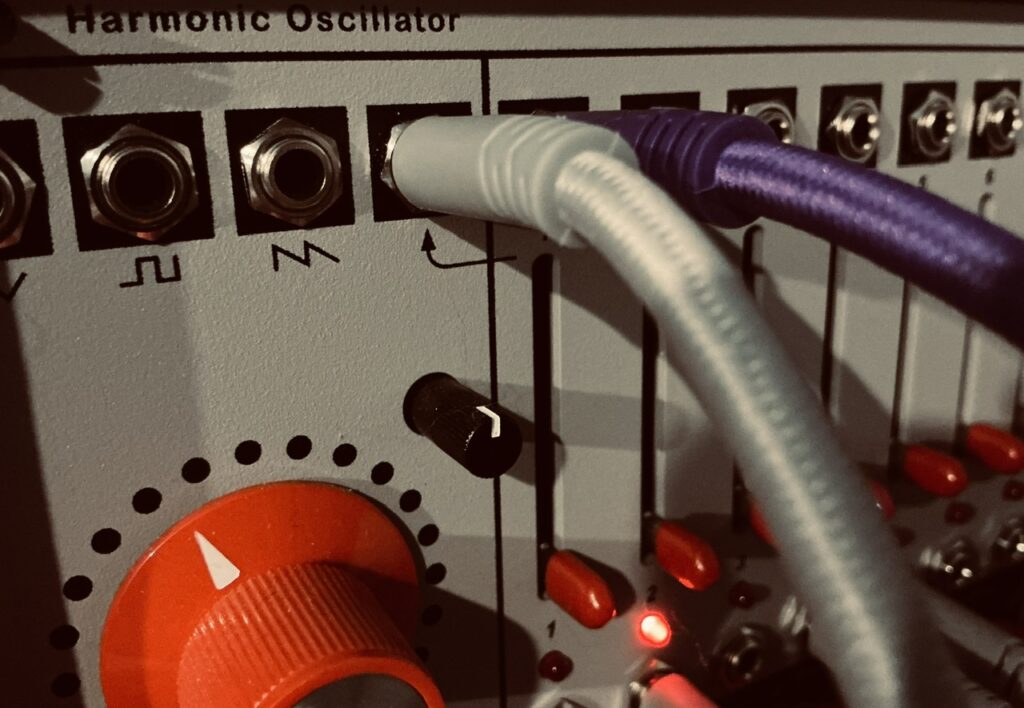
When I stepped up to the synth a few days ago I had it in my mind that I would continue on my Adventures In Fading, only using an entirely different subsystem. I ‘ve recorded a few Fading patches made with my Make Noise system, a couple with Xaoc Devices, one with Instruo, and perhaps others that I’m not recalling at the moment. I wanted to use my Verbosian Subsystem, with the OG Voltage Multistage sequencing the Harmonic Oscillator, Fading through the Amp & Tone, and finally through the Multi-Delay Processor for some of its lovely texture before being put into beautiful stereo via the Scan & Pan. But I had a problem. I wanted to use the Voltage Multistage as a 16 step sequencer, via the Sequence Selector, but I couldn’t remember how to patch that up, and I was too lazy to investigate it, so abandoned the patch in favor of one that was far more straightforward.
This patch started with a simple F2 drone of the Verbos Harmonic Oscillator’s sine fundamental directly into one of the inputs on the venerable Multi-Delay Processor. Not only is the MDP a slick eight tap delay that can do all sorts of fun rhythmic echoes, but it’s also an exceptionally good sounding preamp that really adds weight to the input, and adds a bit of hair in all the right ways. Rather than using any of the summed outputs, I chose to use four separate delay tap outputs from the MDP to the four inputs on Scan and Pan. Using the Multi-Delay Processor in this way allows one to create an enveloping stereo field from even the most basic sources. The sound constantly moves and flows back and forth in the sound stage as a premonition of sorts; bits of sound appearing and disappearing all around you. And because each tap of the MDP is progressively more and more lo-fi, no appearance of the sound is exactly the same. What is introduced earlier is also introduced later, only in a slightly different form. The MDP really is a coup in delay design. It’s a delay, but it’s also something more. It can thicken sound, or give it a bit of added drive in the typical Verbos fashion.
But with my change of plan, using only the fundamental pitch just wasn’t enough. This was no longer a simple sequence driving a sine wave that would be processed through a filter, but the bedrock of a patch that would use many different component parts via various processes. I had to search for more, and the answer came in the form of the Polyphonic Envelope, triggered by the Voltage Multistage. The VMS, like the MDP and Harmonic Oscillator, is a staple Eurorack wonder. It’s an analog eight step sequencer with two lanes that flow together and is eminently patch programmable. I’ve had the VMS for about two years and have barely scratched its surface. But because it’s so flexible I decided that it could be used as the heart of the patch, driving several parts, even if with a little help.
In most of my patches that use a sequencer I use an external clock, even with those, like the VMS, Oct-Tone, and Moskwa II, etc, that have their own clock generating capabilities. But this time was different. I didn’t really want a steady clock, or a repeatable stream of pulses. But unlike many sequencers with its own clock, VMS is a bit different because its clock can be modulated, and this is what I wanted. Sometimes the VMS would move along at a snails pace, sending out gates very slowly, while other times it sped through quickly. And I didn’t want those speed oscillations to be anything resembling regular. One could use any number of CV signals to affect VMS’s Time. LFOs, envelopes, one of the CV outs from the VMS itself, random CV, or anything else one might imagine. But with this patch I decided to use the wonder of chaos. And not just any of the wonderful chaos modules that I’ve used time and again, but a new offering from the chaos master, Nonlinearcircuits. Enter How’s The Serenity?
How’s The Serenity? is described by Andrew as,
This module is a set of 4 reverse sigmoid chaos circuits, running at different frequencies[.]
[…]
The reverse sigmoid circuits are similar in concept to the mackey-glass based design used in the NLC Frisson, but are greatly simplified to a bare minimum of parts. Simply an integrator, two all pass filters and a nonlinear stage with two feedback paths.
If I’m being honest, I don’t really know what any of that means. I’m just a musician who uses tools that are far more technical than I can rightly comprehend. But the comparison to another of Andrew’s chaos modules, Frisson, piqued my interest very quickly. I’ve used Frisson in many different ways in many patches and I’ve found its chaos to be both interesting and useful despite having little manual control over its output. I figured that this new one might be the same. And, since I’m being honest, its size along with those chunky blue capacitors called to me. Before I had even heard any demos or read any reviews I contacted the builder I use for all of my NLC modules and asked him to make sure he added one to his next parts order. I’m glad I did.
How’s The Serenity? has 12 separate outputs that are in four groups of three. From left to right, each group becomes progressively faster, ranging from glacially slow on the left to fairly quick on the right. There are four CV inputs and four sync inputs, one to each section, though they can also be used without inputs so that each section might effect the others in a chain. In the module description, Andrew notes,
The intent of having 4 different circuits running together with pots to get them to influence each other is to have a module that can create longer tracks with many different but related musical events happening and, of course, weird delayed CV effects. Think of a band where the members all do their own thing but every now and then the sounds and patterns connect and achieve structure, which slowly scatters and reforms in new ways.
Though the Voltage Multistage acted as the heart which triggered nearly every aspect of the patch, How’s The Serenity? was the puppet master, controlling VMS’s time according to its own will. VMS told the Polyphonic Envelope, and later the Disting NT, when to do the thing, but at the direction of How’s The Serenity?’s whimsy. VMS was the Sergeant in the field directing his men, while How’s The Serenity? was the General back at headquarters giving him orders in real time.
I’ll note up front that I did not use the CV outputs from the Voltage Multistage for any part of this piece. Those were left completely unpatched, using only four of the individual step gate outputs to trigger the Polyphonic Envelope, and the Gate Out output to trigger samples in the Disting NT (more on that later). These four envelopes of the Polyphonic Envelope triggered by the VMS each went to a different harmonic VCA input of the Harmonic Oscillator,1 ringing out at an ever-changing pace as the VMS moved through each of its steps. Depending on the current speed of the clock at any given moment, controlled by How’s The Serenity?, those harmonics would ring as individual tones alongside the fundamental, while at other times they would manifest as plucked chords (of a sort), allowing the foundation of the patch to remain firm in the fundamental, yet still with the ability to move and be unpredictable with ever changing movement of its upper harmonics.
In a bid to have some form of Fading in this patch, these upper harmonics were patched from Harmonic Oscillator’s mix output to be Faded through the Amp & Tone. Though I’ve used a simple triangle function to modulate the filter’s cutoff frequency in every Fading patch I’ve done, except one (that I can recall), I chose this time to continue experimenting with the technique by using another chaos generator, The Hypster. I initially patched a simple LFO from the brilliant Instruo Ochd, but later decided to try with a bipolar chaos signal to introduce a bit of variance where there was otherwise none. Although this part of the patch was technically Fading, I’m not sure that I hear its result as dramatically as I had hoped. Whether because of the timing of the CV signal in conjunction with the audio, or else because this particular output wasn’t strong enough to adequately cover the full range of harmonics I’m not sure. But while some Fading can be heard, it’s far more subtle in this patch than what I wanted to hear. The Faded harmonics output from Amp & Tone was then patched to a second input on the Multi-Delay Processor where it was mixed with the fundamental output of the Harmonic Oscillator and made stereo through the Scan & Pan before being sent to the Addac814 6×6 Stereo Matrix Mixer.
The Voltage Multistage – How’s The Serenity? duo didn’t end its work with triggering harmonics of the bass fundamental note. In fact, the real magic of this pairing had yet to be revealed. The Gate Out output of the Voltage Multistage was patched to the Disting NT, via an excellent little switch, the SS14 by Xodes, which triggered Spitfire Audio Music Box samples. Just as with the triggering of Harmonic Oscillator’s harmonics, Voltage Multistage sped up and slowed down at of How’s The Serenity?’s behest, which created both widely spaced, as well as quick succession plucks.
But How’s The Serenity didn’t stop at controlling Voltage Multistage’s clock. The Music Box samples were quantized to F Major (also in the Disting NT), using, rather than the sequence from VMS (or any other sequencer), another of How’s The Serenity?’s chaos outputs. And How’s The Serenity? lived up to Andrew’s description. I actively heard many times that sense of disorder turning into order, only to scatter again before regrouping. There was at least one moment during my pre-recording run-throughs where I actively clapped for its performance. Because How’s The Serenity? is chaos its signal is not regular. But also because it’s chaos it’s not random either, and pattern-like behavior emerges before breaking down and coalescing once again, often in highly compelling fashion. Parts repeat, until they don’t. The melody was seemingly random, until it wasn’t. And working two of the outputs in tandem, one to control the clock and another to determine pitch, demonstrated how these different signals, yet still related, interact to form something wondrous. And How’s The Serenity? Didn’t stop there. Several other outputs were used for standard modulation purposes from parameters of the patch.
The music box samples were patched directly to the always awesome Industrial Music Electronics Malgorithm MkII as an insert effect. I could have used the bit crushing algorithm in the Disting NT and saved myself some patching, but Malgorithm isn’t only a top shelf bit crusher and sample reducer. It also contains various ways to FSU using a set of digital waveshapers. Some completely pulverize the sound in several ways, which is great in some circumstances, but if one is careful about the particular algorithm(s) used, along with some experimenting with the input volume, some of those waveshapers can be used quite subtly and beautifully. In this patch that waveshaping manifested into some added noise that really suited the moderate bit crushing and sample reduction of the music box. From the Malgorithm, the output was patched to the Addac814 and was sent to several effects. Chiefly among those effects were the Elektrisk Dradd(s). In fact, I probably should have just used the Dradd(s) as an insert here as well. It wasn’t meant to be a simple effect for the music box, but as an integral part of that entire voice. While the Malgorithm-ed music box cut through the soundstage, the Dradd(s) bookended the other side of that sound with trails reminiscent of a granular string orchestra delay, leaving a wake of granulated trails that really excited the stereo field of the soundstage and enabled those sounds to come alive.
On many days I would have been satisfied with what I already had going. A low drone accompanied by various of its upper harmonics, and a melody (of sorts) using samples is kinda my jam, and I’ve recorded several patches under this rubric. But today I was feeling both a bit ostentatious as well as eager to use a couple of modules I hadn’t used in a while, plus another that I’m just beginning to learn. The first module I had in mind was the mighty Rossum Electro-Music Panharmonium. I can’t rightly recall the last time I used it in a patch, though I know it’s been at least a year, and I knew it was just the right sort of tool to add some harmonic complexity that would otherwise be difficult to come by. One thing I’ve learned about Panharmonium is that less is very often more. The less you throw at its inputs, the more it’s able to produce something magical. Send too much and you’ll get the sort of clashing dissonance you generally don’t want. And so I kept to that simplicity, first sending only the music box melody and its trails from the Dradd(s), and later in the performance also sending the Harmonic Oscillator drone. Set at one octave down, introduced at about 1:45 into the recording Panharmonium was able to provide harmonic depth to the piece; a soup for the rest of the parts to float in. Panharmonium was never a focal point in the patch, but it provided an important aspect to the final result. You can’t really pick it out as a single part, but it would be very noticeable were it gone. For me this is the magic of Panharmonium. It’s rarely the star of the show, but its contributions to a piece put it over the top in a way that no other module does. And when it is the star of the show, Panharmonium stands out unparalleled in beauty.
Though not formally introduced into the recording until about half way into this 22 minute dreamscape,2 the Cutlasses Instruments Gloop was also a module I wanted in this patch. I’ve had several loopers, and still have a few, and Gloop is king of them all. There’s something exceptional about the four play heads that gives Gloop a flexibility others simply don’t have. The UI can be cumbersome to navigate, though according to an email from this morning, a new firmware (1.4) has just been released which adds more features, but also simplifies menu navigation making Gloop navigation a far more straightforward and efficient process.
In this patch I used one of my standard methods for playback with Gloop. The two outside playback heads, one and four, were set to 1.5x and 2.0x respectively. But this time was a little different. In most patches I would hard pan those sounds to the left and right, but using playhead one as more of a granular playback head focused on a very small bit of the buffer at a time, I decided to use two chaos signals, one from How’s The Serenity?, to modulate its position within the playback buffer, and a second from from The Hypster to pan its position within the stereo field. Playback head four was also modulated in the stereo field by yet a third chaos signal from The Hypster. This allowed the sound to dance around the stereo field as if it were its own personal stage in a grand hall.
Playback heads two and three were set to .5x and 1.0x respectively. I almost always want some portion of the buffer to playback at 1.0x, panned to the middle, to act as a reference point for the rest. What good is playback at 2.0x if 1.0x isn’t also represented. Without slow, there can be no fast. Playing back the buffer at the original speed is an anchor point; a way to provide a center for all of the other playback heads, though it works best when juxtaposed with higher speed playback. The last playback head was likely the most impactful in this patch however, set at .5x and panned in the middle. As Hainbach often notes in various ways, particularly about tape machine playback, half speed is the best speed. Half speed lends spiritual weight where there was none. Half speed slows everything down and allows the listener to focus in on each moment. It adds a sense of intensity few other avenues can provide. And those things were all accomplished in this recording with the half speed playback head. Altogether Gloop’s four playback heads created a world unto itself. A spot lit section of the piece where we witnessed both the heft of the whole played back at half speed as well as the fluttering about of very small bits as if sprites in a field of wonder.
Lastly I wanted to once again use the ever-beautiful Chase Bliss Audio Mood Mk2. I was so enamored with its product in my last patch that I felt compelled to return to it so that I might further explore its secrets. Though used in the same mode as A Xaotic Mood with the same effect on the Wet Channel, I knew I hadn’t yet touched upon more than a small portion of its capabilities. Though using Mood in a patch alongside the Dradd(s) might perhaps be superfluous, if not gratuitous, I still felt like it could add and not subtract. Though both are nominally granular processors of a similar sort,3 they still sound quite unique from one another. Firstly Mood requires that one record a snippet of audio to the buffer, whereas the Dradd(s) are realtime processors.4 This fact puts the Dradd(s) in a position to be played as a sort of granular delay in a way that isn’t really possible with Mood. But playing out of a defined buffer that can be dubbed over and again, with sounds fading away as they loop around, is absolutely magical. In this patch I likely had that degradation set a bit too high. Sounds degrade only as newer sound is recorded, which meant that I had to hold the dub switch a lot more than I truly wanted as I tried to fade out. But as predicted Mood was able to justify my insistence on using it, even if I had the send input into Mood too high.
The music box from Disting NT (through Malgorithm and the Dradd(s)) and Panharmonium were both sent to the always dream-scape-y Holocene Electronics Non-Linear Memory Machine for some delay. The time was in the medium zone and set at about noon which is probably about a second or perhaps a bit longer. I’ve always been of mind that a goodly part of the NLMM’s mojo is due to it not being syncable. You have to find what you want by feel and personal discretion alone. Feedback was set moderately high, at around 11 o’clock. I tried using the pitch shifting functionality, but it never sounded quite right alongside the rest of the track.
All of the voices, the Verbos harmonic drone, the music box and its accoutrements, Panharmonium, Gloop, and Mood were all sent to the always lovely Walrus Audio Slöer. As a change I used its core algorithm, dream, rather than one of the two octave shifting algorithms I tend to use. At times it added a beautiful wooziness from the two levels of modulation, though a bit more wouldn’t have hurt.
Harmonics 2, 4, 5, and 8, which corresponds to F3, F4, A4, and F5 respectively. ↩︎
Gloop was actually present in the recording the longest of any voice, though only in the form of tape noise. ↩︎
Both Mood Mk2 and the Dradd(s) have similar forms of time stretching, as well as simulated tape playback. ↩︎
I am fully aware that the Dradd(sj also record to a buffer before processing. The difference is that Mood requires direct action to record, whereas the Dradd(s) do so continuously. ↩︎
There’s a sequencing technique that I’ve been exploring over the last year or so. Though I’m not vain enough to believe that I’m the first to use this technique, I can’t say that it’s one I’ve heard often, if at all. It’s not a technique or patch that I’ve seen discussed anywhere, whether online or in any of the various modular synthesis books I’ve perused these last several years. It’s not a hard technique. In fact, it’s quite simple. I call it “Fading.”
Though not difficult, Fading, to me, is intoxicating. It allows short(er) sequences to have a sort of variation that simple random or probability-based techniques can’t readily provide. Random bits within sequences are great. Occasionally you’ll get a random pitch in place of the programmed note in the sequence, but the variation is minimal, and if you use random on too many of the steps, the sequence is no longer identifiable. Probability added to, or substituted for, random is also cool, but the effect only goes so far. Occasionally a note in a sequence will not be played, or sets the likelihood of a note playing a random pitch. These are all great effects, but they don’t provide something truly unique. Fading is different in that it introduces variation in a somewhat chaotic manner. What then, exactly, is Fading?
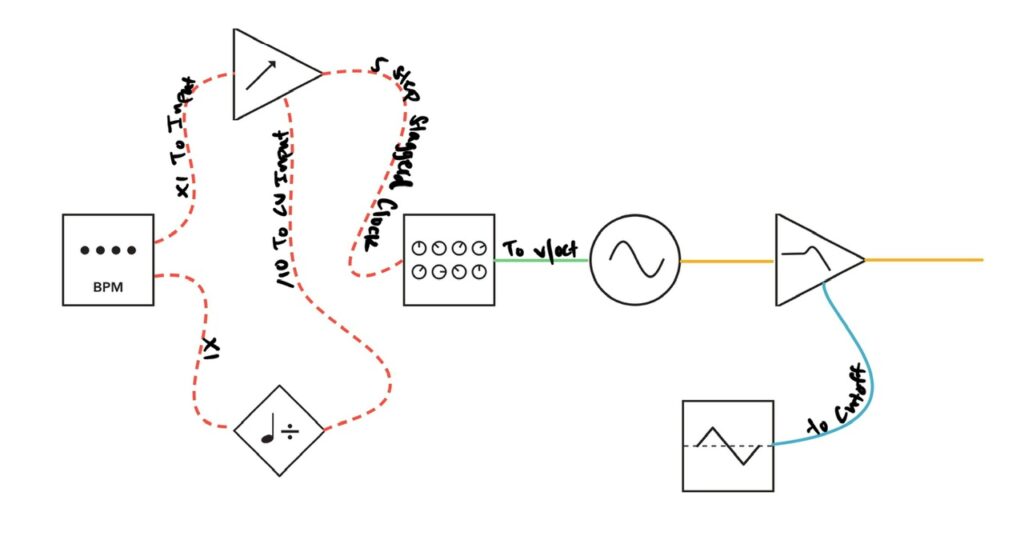
Fading is the process of using a staggered clockto drive an un-enveloped, sequenced sine wave through a highly resonant low pass filter with its cutoff frequency being slowly modulated such that sometimes some of the notes in the sequence cannot be heard while others are sometimes accentuated.
There are several sorts of variation that Fading introduces to a sequence. The staggered clock1 assures that repetitiveness is kept at a minimum, so long as the stagger is not divisible by the number of steps in the sequence.2 A staggered clock, rather than facilitating an ongoing, repetitive sequence, also allows for dramatic holds. Modulating the cutoff frequency ensures that notes disappear and reappear, sometimes dramatically in an almost ghostly manner. Sometimes a note may not be heard at all, while at other times growl, and sometimes distortion, is introduced when the note of the sequence and the cutoff frequency are in alignment. There are sometimes drastic volume changes from barely there to screaming, and all of it is done organically as notes pass through the filter. It all depends on where the cutoff frequency is at a particular time. The combination of sequenced pitches alongside an ever-moving cutoff frequency is a rudimentary form of chaos. The process is determinative, and could be predicted if we knew the exact speed and range of the modulation, the exact offset point in the filter cutoff frequency, and the frequency of all of the notes passing through. But since we don’t know all of those factors, the outcome itself cannot be predicted exactly. The result is a dance of notes that seem to float in time and space, and the sequence becomes something more than a set of notes played by an oscillator.
This patch started with the Sitka Instruments Gravity, a basic clock with few bells and whistles with a tempo of 58BPM which was sent to the input of a VCA as well as the Nonlinearcircuits Divide & Conquer. With a clock source like Pam’s this extra step isn’t needed, but Gravity only outputs short triggers, rather than gates, and using a clock divider was the only way to get the five on five off staggered clock. With a little patch programming of Divide & Conquer, specifically using the /2 output to the input for the 5/2 and /5 outputs, I was able to get a /10 division of the tempo which output a gate with a 50% duty cycle. This gate was sent to the CV input of the aforementioned VCA, creating a five step on, five step off clock. The output of the VCA was sent to the external clock input on Moskwa II in order to drive the sequence forward.
Moskwa II is one of my favorite sequencers. It’s eminently playable, feature rich, and nearly every facet can be modulated. Like every other Xaoc Devices module I’ve used, Moskwa II takes modulation, even heavy modulation, quite gracefully via its expander module, Ostankino II. It’s only shortcoming, which can be remedied by pairing it with a second unit, is that it’s only eight 8 steps rather than 16, though Xaoc definitely provides avenues in order to mitigate the potentiality for repetition. While the patch starts cycling through its eight step pattern in five step increments, as the piece rolled on, I slowly began to introduce modulation from a self-modulated Batumi II using 4-way cross modulation3 in order to create chaos-like LFOs, and Zadar, via some offset and attenuation in Samara II, in order to effect various facets of the sequence. Random, Slew, Probability, and the First and Last Step parameters were all modulated at different rates and ranges. This allowed the sequence to move, as if alive. It could be as many as eight steps, or as few as four, and could start or stop on any sequential set of steps in the sequence. At one moment all eight steps were active; the next could be four, five, six, or seven steps, and begin and end in different places in the ring. These steps were also moderately slewed and randomized so that any given step might be any of the currently active steps, and step three and five might slew dramatically or not at all.
The pitch CV from Moskwa II was patched to the v/oct input on the ever-glorious Odessa, set in five voice mode with some slight detuning. The Fundamental output was patched straight to Zagzreb as the filter. Normally I would only use one output for a patch like this, but I specifically chose to use the stereo LP24 outputs because summing the fundamental sine wave was just a bit louder and more prominent in the mix. I experimented with modulating the Spread, but the effect wasn’t really compatible with the Fading technique I tried to foster through this patch, so I quickly abandoned it. The cutoff frequency was modulated using an offset and attenuated cycling triangle wave from Zadar, set at a 20 second cycle. The time was arbitrarily set by ear to what I thought sounded good, careful to not allow the cycle to introduce too much silence at any given time. Fading requires a delicate balance of the knob offset on the filter and the modulation depth. Too high of an offset and you get too many notes; too much negative voltage modulation and you get long periods of silence. Sometimes I like to work with the offset below the lowest note and only modulate upwards. Other times I prefer to set the offset closer to the mid-point and modulation in both directions. A lot is dependent on the filter itself, and it’s rarely the same for any two filters.
But in this patch, using just the fundamental sine wave seemed too basic. I wanted something more, without being distracting. Fortunately Odessa is capable of many sonic feats, and partials fluttering about in the stereo field is one of them. In many patches I’d opt for something like piano samples of pinged high pitch sine waves to serve as ornamentation, but today there was no need. Sending one of the chaos-like LFOs to the Bank Length was all the ornamentation necessary to complement Odessa’s sine wave melody, and because the partials from the Even and Odd outputs are all derived from the Fundamental, everything just worked. I did choose, however to not filter this voice. The volume is quite low, almost like a chorus of bugs in a distant tree line, or hearing a casino just close enough to be heard, and didn’t clash with or detract from the melody so I let it ride without any processing besides effects.
Both the filtered fundamental and its choir of fluttering partials were sent to the ever wonderful Samarkanda for some creative stereo delay. The settings are rather basic; a simple quarter note clock, which was slightly multiplied on one side to create some subtle stereo movement. I also sent the feedback output to the ever wonderful Bizarre Jezabel Mimosa to add a bit of fizz to the delay trails. I meant to introduce this effect well into the recording, but I forgot to lower the input level before I hit record so it was ever present through this recording. The effect, however, is subtle enough that it didn’t matter much. T added a tasteful amount of noise to the overall signal.
With the melody and its complement in place, it was time to add some warmth to the patch. The sine waves from Odessa are beautiful, but most of the pitches in the melody are fairly high, and of course its partials even higher. Fortunately, Xaoc has the perfect companion: Sofia. My initial thought was that I’d use its slightly overdriven fundamental as a drone, creating some movement with the stereo Elements it can create, but that was a dead end for me. It wasn’t terrible, but it never did sound right. The Elements were distracting no matter how low in the mix I tried to put them. The best outcome was still too much, and so decided on a straight fundamental. I was remiss by not trying to modulate its level slightly, even if only a small quiver or waver, but that wasn’t something I thought of until I’d heard the recording several times. This bass drone sat very deep in the mix. It didn’t need to be prominent, but merely present; something to add a smidge of weight and a slightly darker color to the piece, and Sofia’s slightly saturated sine worked a treat.
But the patch wasn’t over. Despite this patch being about Fading, it wasn’t everything. One piece of gear I’ve had for a while but which has gone criminally underused is the wunderkind Chase Bliss Audio Mood MkII. I can’t rightly explain why I haven’t used it much. If I were forced to give an explanation I’d likely say that I’m one of those guys who buys gear in chunks. I can go six months with nothing new, but then I’ll go on an ill-advised spree and purchase several choice pieces in a short span. Though this means I’ve got gear, it also means I don’t always take the necessary time to use it and learn its intricacies. Such is the synth life, I suppose. But today was a day that I’d had enough of staring at this beautiful lavender box that I knew held many wonders.
At first I was a bit unsure. I’d used it some before, but never enough to know what I might like from it, or how to get it. After a couple hours of exploration I decided on using Stretch Mode, which acts as a time stretcher of sorts. At first I sampled just one snippet of the prefade mix of Odessa’a filtered fundamental and its partials, and although that was nice, the magic didn’t really start to happen until I started overdubbing bits of the sequence. Along with generous amounts of Fade so that as newer material was recorded, older bits within the buffer slow fade away Frippertronics-style. Once I introduced Mood into the mix, I lowered the sequence to a level that was barely audible except for during very quiet parts of Mood’s output. I wanted Mood to be the star of the second half. I manually modulated both Length and Modify, changing grain length and playback direction and speed respectively. I used most of the range for manipulating Length, but I generally kept Modify in the 10 o’clock to 2 o’clock range, not wanting playback of the grains too fast. When I wasn’t wiggling knobs, I was overdubbing. As the piece started to come to a close, I opted to record silence into the buffer while allowing the older bits of audio to fade away gracefully so that the piece might conclude gracefully. I’m quite awe-stricken with the result of Mood in this patch. It’s a beautiful machine, and I shan’t neglect it again.
All three voices, Odessa’s melody and ornamentation along with the delays output, Sofia’s drone, and Mood’s granular smoke show were sent to the ever-beautiful Walrus Audio Slöer reverb, with an octave down effect, and a bottomed out clock for a bit of lo-fi goodness. In a discussion on Modwiggler another user, Starthief, and I were discussing some of our favorite reverbs. We both agree that Slöer is beautiful, but that it’s not quite lo-fi enough. That its clock should go even slower to introduce more aliasing. But one thing Slöer excels at are the details at the edges of the sound. A close listen will reveal the reverb sort of falls apart at the edges. A slight bit of crispiness that falls away not unlike animated pixels falling away from its previous form. Slöer has been my go-to reverb since I got it. I highly recommend checking it out.
A staggered clock is one that is sometimes on and sometimes off. For instance a five step staggered clock will be on for five beats, then off for five beats. ↩︎
If you use a clock that is divisible by the number of steps in the sequence you’ll have repeating patterns which is definitely not what we want. ↩︎
Four-way cross-modulation involves using each sine wave output to frequency modulate the next LFO in the chain. LFO 1 modulates LFO 2, which modulates LFO 3, which modulates LFO 4, which cycles around to modulate LFO 1. This feedback method creates chaotic signals at the outputs. ↩︎
Nine months ago I set up a patch on the main synth for which I had plans. I’m drawn to all sorts of music. Having spent my younger years as an orchestral brass player, classical and other forms of orchestral music have long since been in my listening rotation for decades. What started with Tchaikovsky and Brahms in junior high led to more modern composers like Ólafur Arnalds, Jóhann Jóhannsson, and Max Richter in my thirties and fourties. Several years ago while perusing a “What am I listening to?” post from my favorite artist, Steven Wilson, I happed upon Max Richter’s album Three Worlds: Music For Woolf Works. It’s the soundtrack for a modern ballet by Wayne McGregor about the life of British author Virginia Woolf. From my very first listen I was captivated. Tuesday, the final track of the album, a nearly 22 minute piece, was especially beautiful in a way I find hard to describe. For years I’ve returned to that track as a means for emotional support. And on an August day last summer I decided I wanted to do a version of Tuesday using both acoustic instruments like xylophone and a Tascam Portastudio, as well as Chromaplane and a full modular synthesizer.
My plans were grand, and what I wanted to do was clear in my head. I made sheet music, transcribing parts by ear. I rehearsed those parts until they sounded good enough to move on. But what started as a manageable project turned into a reality check. My goal was to perform the entire piece in one take, as I do for all of my recordings. I knew it would take a lot of rehearsal, but I was okay with that. And then I got stuck. I ran into problems I couldn’t overcome, both with my skill level and my gear. There were some things even intense rehearsal couldn’t sort, or at least I couldn’t figure out how to sort them, and I had issues understanding how to mix many more outputs than I had inputs for. So I let the patch sit with the idea that I would take some time to figure it out, or at least find some way to keep moving forward. But I never did figure it out, and yet the patch continued to sit, over a hundred cables draped about, sprawling across the synth like cobwebs on an old bookcase. I had hopes. I had plans. And for nine months it sat; the memory of its machinations fading further by the day. It wasn’t until recently that I realized I either needed to shit, or get off the pot (as my mom used to say). After nine months of exclusively playing my Make Noise synth I was itching to play my main synth again, and I finally came to the realization that if I wasn’t ready to immediately resume working on it, the patch on the wall had to come down. A few days later, I finally took it down. I knew that I’d never again get what I had, despite some pretty thorough note taking, but at the same time I knew I couldn’t use it. It was bittersweet.
A few days later I decided it was time to finally patch the main synth again. After nine long months it was overdue. And when I walked up to it to get started I was filled with emotions, and, if I’m honest, slightly intimidated. My Make Noise synth is pretty large and fully featured. It’s not really wanting for anything that wouldn’t be gratuitous at this point. But my main synth is about two and a half times larger and with a whole lot of modules that are complicated. I hadn’t used any of them in a while, and I balked.
This is not like riding a bike.
But rather than stare at the wall in a fit of paralysis I decided to make a definitive choice. The base of the patch, like my last Make Noise patch, Sketch 23, would be a fixed chord that was level controlled by nothing other than chaos. Although Spectraphon can certainly be used in a low frequency chaos mode as a modulator, it functions very differently than the chaos circuits from Nonlinearcircuits. And if I’m honest, I missed using modules like The Hypster and Let’s Splosh. Chaos was an immediate infatuation when I got my first chaos module, the venerable Triple Sloth. That first module sent me down a hole of research into what chaos is as a scientific and mathematical principle, and I felt like it was a good parallel to life. I’ve used it consistently ever since.
Although the patch is structurally similar to Sketch 23, and is performed in a similar way, how it was put together was very different. Having decided to use a chaos driven chord as the base, I immediately started patching the X, Y, Z, and U outputs of The Hypster to the CV inputs in the ever-flexible Intellijel Amps. As I began to connect the patch cables from The Hypster I wasn’t exactly sure which quad of oscillators I wanted to use, but at this point when someone mentions a quad oscillator my mind immediately goes to the Synthesis Technology E370. It’s extremely powerful, and very flexible. And because I wanted to minimize any issues with the patch as I progressed, I decided to use a familiar set of wavetables made up of sines along the X axis. My original intention with Sketch 23 was to use a E7 chord, but for some reason ended up with a straight EMaj7 chord, so I rectified that oversight in this patch, only in a higher register. The waves were quite simple. A bank of sine waves that move up and down the harmonic series. In order to create harmonic movement, each of the wavetables were modulated by four outputs from the very awesome Nonlinearcircuits Frisson. If I’m honest, I’m not sure what sorts of waves Frisson produces. I’ve never put any of the outputs, which should all be reasonably similar, though each with a different phase and amount of slew, under a scope to get a picture of Frisson’s general wave shape. But I’ve used it a bunch, and, like most chaos, it’s definitely periodic. Each oscillation just slightly different from the last. These differences bore out in the patch with how the harmonics would flow up and down with each pass of the CV. Sometimes the harmonics rise and fall quickly, while others move a bit more methodically. Though the top note of those harmonic progressions had a ceiling set by attenuation, that top note wasn’t always the top note. Sometimes it was a pitch lower. Sometimes more. The movement was generally predictable, though not really. Just as chaos ought to be.
Using the chaos outputs from The Hypster to control audio levels requires some thinking and tinkering. Not because of some complication, but because the four outputs can vary wildly in their output levels. The X output is about 6V point-to-point, ranging from -3V to +3V. Outputs Y and Z range like a standard LFO, from -5V to +5V. U, on the other hand, is a hot signal that can have a massive 20 volts point-to-point, ranging from -10V to +10V. I’ve used these signals from The Hypster for similar purposes before, and I knew about these voltage differences between the outputs, but it had been so long that I’d forgotten all of the information except that output U was the strongest one. That mis-remembrance, along with a solid dose of stubbornness by refusing to RTFM, caused some early frustration. I fiddled with the CV knobs of the VCA for what seemed like hours, even if it was only a few minutes, in order to get the balance I was looking for from each chord tone. And I continued to refine and tweak those CV attenuation knobs all the way through recording this patch. Adjusting this one part of the patch was a recurring theme from beginning to end. My problem was two-fold. I wanted the fundamental of the chord, E, to have the strongest level, while needing to tame the highest tone, D. I had some level of issue with both. Using the U output for the fundamental I’d over attenuate and lose the bottom tone, or else it would it would clip in the VCA. The highest note of the chord, because of the harmonic shifts as the wavetable was modulated, was either too loud, or way too loud, even though the CV level from Output Z wasn’t particularly hot. It took a while to coax that channel to a reasonable level, and even still it probably could have been a bit lower in volume.
The Hypster’s Frequency was low; below 9 o’clock on the knob. Gain was set moderately high at about 11 o’clock, while Damp was set to just above 9 o’clock. All three of The Hypster’s CV inputs were modulated by three outputs from Triple Sloth. Frequency was regulated fairly lightly. I generally don’t want modulation that will have drastic speed differentials. I like a signal that can move slightly faster and slightly slower, more like a natural ebb and flow than purposeful or dramatic increases and decreases. As a means to keep the signal from becoming too much like a standard sine wave Damp received about the same amount of attenuated modulation as Frequency. Gain, which influences a number of attributes in the U signal (from which all of the other signals are derived) before it goes through the various chaos circuits was modulated more heavily, which kept the level and amount of feedback at generally high levels.
These chord tones, modulated through the harmonic series by The Hypster served as a cloud of ghosts. Each tone drifted in before slowly drifting away. The movement was subtle; almost dainty. This floating chord was then sent to a pair of Echofix EF-X2 tape delays for some echo action. Feedback was set reasonably high. Were it even just a little higher we’d be on the edge of self-oscillation. And these beautiful repeats danced in the stereo field, first with the third chord tone (G#) and fifth (B), the third and its harmonics climbing upwards in the left channel, followed by the fifth and its harmonics cascading downwards in the right. After a bit, the seventh (D) was also modulated up and down, though because of its presence, I decided to keep it centered. I thought about sending that tone on a panned adventure moving back and forth in the stereo field, but I reasoned that it would compete a bit too strongly with the stereo separated movement already happening. The repeats are already delicate enough. I saw no need to box them out when I didn’t have to.
Like Sketch 23, these chord tones and their movement were the inspiration for the patch, but they needed a more substantial base. Enter Chainsaw. The Acid Rain Technology Chainsaw is not a new module. It’s been around for several years, and even if it’s been replaced by an even more feature packed Ripsaw, it’s still a quite powerful, and immensely popular oscillator. Though paraphonic, a form of polyphony where each individual oscillator does not have its own discrete signal path, Chainsaw is capable of producing up to three note chocrds using three separate v/oct sources. It’s a huge sounding oscillator, capable of producing a 21 oscillator swarm that morphs from rich saw waves to a wonderful array of square waves. The various oscillators can be detuned from just slightly to absolute cacophony, and it’s a drone master. I had three separate v/oct signals from the Elektrofon Klang patched to Chainsaw, though two of them were identical in a bid to reinforce the bottom note (E1). As a way to add more harmonics I also had Chainsaw play a B2 (power chord 🤘) for a two note drone. Using Frisson to modulate both the wave shape and the detuning created a perfect amount of movement to keep it from becoming stale.
Initially I ran Chainsaw right to the mixer, but the waves were simply too rich and drowned out the floating chord I’d worked so hard to get, and so decided to run it through a filter. Choosing a filter this time was a bit difficult. My first inclination was to use the Bizarre Jezabel Seju Stereo, but the right channel simply didn’t work. I’ll have to test that further at some point, but it meant that was out of the running (which is a shame because the filter sweep sounded ace in the one channel). Next I tried the Bizarre Jezabel Pkhi Mk3, and although it was nice, it wasn’t special. It was fine. I then tried the Bizarre Jezabel Blossom, a spin off of the venerable Mannequins Three Sisters, but didn’t really care for the more drastic differences between the channels in this application. Although Pkhia is physically closer to the Chainsaw than all but the Seju Stereo, I didn’t try it until last. It’s not that I don’t like it. I do. But I’ve used it a lot and was hoping one of the others would be right for the job. Pkhia is a very interesting filter. It’s a multimode filter with simultaneous stereo LP, BP, and HP outputs, with shared resonance and filter cutoff. In a small twist, you can modulate each side’s cutoff frequency separately to create some very interesting movement in the soundstage, which greatly enhanced and accentuated the movement of Chainsaw. Two outputs from Frisson were patch to each side’s CV input to have an organic flow. As an added bonus, although I didn’t use them in this patch, Pkhia also has a switch to use it as a sort of DJ filter, with LP on the left channel and HP on the right channel. Pkhia also has a VCA with CV inputs. This filter can be both subtle or rich, and embodies the “sweet” nature of Bizarre Jezabel Filters.
With the chaotic chords and bass drone settled, it was time for embellishment. I was initially hesitant to go an already well travelled route by using the Poly Multisample algorithm in the Disting NT. I’ve done that patch a bunch. But this was my first time back on this synth in a long time, and whether nostalgia compelled me, or else I simply retreated to what I was comfortable with, I don’t know, but Soft Piano is exactly where I landed.
I’ve used lots of techniques to play Soft Piano. Sequencer and gate? Check. Turing Machine? Check. Random gates and CV? Check. Chaos? Check. But perhaps, my favorite technique, even if it often takes a lot of time to set up in a way I like, is to use four chaos signals, in this case -X, -Y, -Z, and -U, to the inputs of both the Nonlinearcircuits Let’s Splosh and Numberwang which produced interrelated gate and CV signals at their respective outputs. If you use cyclical or clocked inputs with these modules, a steady pattern will emerge. But when using chaos, you get a somewhat predictable stream of gates and CV that hint at a pattern, but that are liable to deviate regularly, both in their timing and distribution. Even without modulating the source module, in this case The Hypster, the pattern stretched and contracted; notes stayed the same until they didn’t. That’s the nature of chaos.
I used six total gate outputs from Numberwang, combined with Stackcables, into the two gate gate inputs for the Poly Multisample algorithm, and two highly attenuated and lightly offset outputs from Let’s Splosh into two pitch CV inputs. These four signals controlled eight simultaneous voices, and it took a goodly while to find the right combination of outputs, particularly from Numberwang, in order to get a piano sound I was happy with.
The stereo outputs from Disting NT were sent to the always-awesome Venus Instruments Veno-Echo, perhaps my favorite Eurorack delay overall. Veno-Echo was set up to be fairly slow, and with a smidge of sample reduction in the feedback loop. Two more gate outputs, picked at random, were patched from Numberwang which turned the Reverse parameter on and off on each side for those occasional intoxicating “zip” sounds of reverse delay.1 A mix of the dry piano and its repeats was sent to what is perhaps my favorite granular processor, the Dradd(s). Although Stereo Dradd was released a fairly long while back, I didn’t jump on it immediately. I’ve been using dual Dradd(s) for a long while and have been happy with the results. Initially I tried it in Grain mode, but just wasn’t all that happy with the results, so I decided to go with Tape mode, and strongly preferred the whacked out tape machine vibe. As this voice was introduced, there was no modulation. The Dradd(s) output an occasional hiccup at half speed. But as time progressed I introduced yet another set of chaos signals to modulate P2 on both Dradd(s), which controlled the speed and direction of playback. At first the effect was subtle. By the end it was a crazed out, all wet affair that sounded like a tape machine away about to simply fall apart.
All of the audio was sent to the always wonderful Walrus Audio Slöer for some lofi, lightly pitched up reverb. Slöer is the perfect sort of reverb for a patch like this. With its internal clock set at the minimum via the Stretch slider, the edges of the audio seemed to disintegrate in highly musical ways; as if notes were falling apart rather than fading away gracefully. It’s a highly compelling effect in the right circumstances, and this sort of patch, inherently filled with noise and digital artifacts, practically begs for that sort of treatment.
The last part of this patch was to use the always fun Industrial Music Electronics Malgorithm MkII. I don’t normally add in a hardware effect on the output bus of a recording, but I wanted this whole recording covered in a high noise floor and with its integrity questioned. My first thought upon patching it in was “Man, I really like the high noise floor, even with the output at 100% dry.” In fact, after hearing it, that noise floor was purposefully introduced as the first thing you hear in the recording. Initially I wanted the output to have a varying amount of both sample and bit reduction to add a certain level variable crunchiness to the output. And while I liked the result, I was taken aback when I experimented with one of the wave shaping modes, even if meant having to scale way back on my initial intent as a means to accommodate it. I’m a huge fan of distortion. I’ve used it a bunch in many patches, and I’m beginning to come around to digital forms of distortion in some applications. That said, the digital distortions in the Malgorithm are anything but subtle. In fact, I’ve generally ruled them out of most patches because they’re simply too overwhelming, and with no way to control them other than with the amount of input volume the modules receive, I haven’t found many applications suitable for them.2 But this particular distortion just sounded so good that I felt the need to use it, even if in the end it might have proven sub-optimal. Because of how overwhelmingly loud Malgorithm’s distortions are, I could only mix the wet signal in very slightly, perhaps only five percent. Any more and the dry audio was completely decimated. This meant that I lost most, if not all, of the more subtle movement created with the chaotic modulation to both the bit and sample rates. Out went the grunginess of hitting a Nyquist Frequency, and in came near full audio destruction. And because the wave shapers on Malgorithm are only an on or off proposition, there was no way to gracefully fade in the distortion, which, in a perfect world, is what I would have preferred to do. The only way to fade in the distortion was to use introduce more wet signal to the mix. It was all or nothing, and I gratuitously chose all.
When I walked up to the synth today, I only had a vague idea of what I wanted to do. I knew I wanted something reasonably simple sounding (even if the technique isn’t simple at all) and slow moving. I’ve been intently listening to an incredibly well done drone-y album by ambient artist Fields We Found, which inspired me to move back into a particular sound I enjoy intensely, but with a twist.
The drone that starts the piece is about as simple a patch as they come. A saw wave from the Sub output of Spectraphon’s Oscillator A through QMMG in LP mode with a high dose of resonance, and the cutoff frequency modulated by an attenuated triangle function from Multimod which produced a throat singing or “Ooooooooohm”-like sound. I never wanted too many harmonics to peak through. Its entire point was to be the foundation of everything, but more of framework off of which everything else might be supported, not a focal point. Everything in this patch was moving, and it needed some kind stability, though not stillness. Despite being the first sound in the piece, this bass drone was the last part to come together. I’ve found that I often compose in the same way I write. An idea will start to materialize, which leads to other ideas. These different ideas get synthesized together (literally!) which lead to yet more ideas for further combining. It can all be quite fluid, but very rarely is it sequential.
QMMG’s output was patched to the Bruxa for texturization and a bit of growl. It seems that no matter the context of a patch, Bruxa can find a way to fit in. It’s one of those modules. In this patch both Decay and Absorb were modulated by Spread triangle functions from the same Multimod modulating QMMG’s filter cutoff, with a side of patch programming its CV output to Time (the one with the attenuverter).
If you’ve read this site at all in the past you’ll know that I adore using very slow, free moving, unsynced waves to modulate the level of sounds in and out. To me it’s an incredibly inspiring sound that never gets tiring. These sorts of drones put me in a peaceful mindset quickly, and that’s something my soul can use of late. In the final track of the aforementioned Fields We Found album there’s one particular tone that is being modulated, either via frequency or amplitude modulation (I suspect it’s the former), and I wanted to try and replicate that sort of feeling, only throughout this patch.
Although I initially imagined Sketch 23 as a patch that would be predominantly be played within the NUSS, I ultimately decided to use a mixture of Spectraphon and DPO as the four oscillators that made up the bulk of the patch. Each oscillator was tuned to a different chord tone. Harmonically it’s a simple CMaj7 chord comprised of a C Major triad, C, E, and G, plus the major seventh B at the top. I know that when I imagined the patch I initially wanted to use a slightly more edgy C7 chord, but for some reason I just didn’t. At first I used the sine wave outputs from each oscillator, but later decided on adding some texture. For the two lower notes, C and E, I used the mixed outputs of each Spectraphon oscillator, though neither were modulated at all, both were set with a relatively low number of upper harmonics, and both had a smidge of FM as each oscillator modulated the other. The two upper notes of the chord, G and B, were sine waves from DPO, with Oscillator B FM-ing Oscillator A. All four outputs were patched to the first QXG, which received CV signals from Polimaths’ channels one, three, five, and seven.
One of the features that has me smitten on the Make Noise Polimaths is that it has a built-in ability to do amplitude modulation as a core part of an envelope. It’s a very unique sort of AM in that it contours with the function itself rather than separately acting upon the function or already modulated audio in a second VCA. And it was this feature, inspired by that one tone in “part five” of that Fields We Found album, that I wanted to not only use, but feature in this patch.
Polimaths is a wonderful module. Though not fit for every modular application, there are many for which it might not just be a good tool, but perhaps the best in all of Eurorack. It’s innovative in so many ways, and was built for polyphonic applications like this one. Even if you don’t pair it with Multiwave or use it with the rest of the NUSS it can find a place in any case. This patched started with already long rise and fall segments, only getting longer via its very excellent Spread Modulation scheme. In this patch lower pitches were controlled by longer envelopes, with higher pitches being progressively shorter. This helps form the pyramid shape of the parts for this piece. Lower, fatter sounds tended to be around longer, with notes becoming gradually shorter as the pitches move upwards. The oscillation amount and rate were equal for all four of the functions I used. Polimaths was set to both cycling and bipolar modes. I didn’t want constant sound. I wanted each chord tone to float in and out on its own terms, each fluttering about through the stereo field. One thing I’d probably change is that once the patch was recorded it seems like the oscillation amount was a bit too high. It doesn’t ruin or distract the listener, but I was going for a more subtle effect. It was more like a medium tremolo as opposed to a light fluttering of each note. It’s just not quite as delicate as I initially imagined, though still quite beautiful and compelling. In fact, it makes me want to learn how to patch these sorts of functions so that I might be able to use them in applications on Subsystems. These sorts of oscillating functions are ultra-cool, and useful in so many ways. All four functions were modulated in QXG such that they panned throughout tye stereo field throughout the piece. Each tone not only gently faded in and out, but also slowly danced from left to right and back again.
With the chords sufficiently flitting about the soundstage, it was time for ornamentation. The chord tones was the major point of the patch, but it was clear that something was missing. Although I tried several different ideas, none of them stuck. Either they were too dry or just didn’t fit. Then I remembered a passing scene in one of the original Echophon videos, and decided that was my path. I was going to finally figure out how to tame the beast. I have a funny relationship with Echophon. It’s definitely not a delay for every type of patch. It can be used like a standard lofi digital delay, but that buries the lede. Echophon isn’t a standard delay. It’s a pitch shifting maker of sonic wonders, but it definitely takes time to learn. And while Echophon is quite old, over a decade old at this point, I haven’t had one for very long, and I just haven’t really tried to flesh out its strong points. But that video gave me ideas, and I was bound to explore them.
Normally with delays I tend towards longer delay times. Most of the stuff I make moves rather slow, and much of my delay use isn’t to induce echoes or repeats, but as a means to stretch out and lengthen tones; a means to fill in space and make already long tones longer. But I quickly discovered that although Echophon can delay up to 1.7 seconds, that’s not where it really shines.1 Echophon has a signature sound. It’s pretty easily identifiable when you hear it. It’s covered up with digital aliasing. The mix knob is controlled by a vactrol so it’s never fully dry. Sometimes that sound is great, but when it comes to much longer pitch shifted tones that sound can become distracting. But with the right input, and the right delay time and feedback settings, those metallic tones from Echophon can sound like Candyland in all the best sorts of ways. A shimmering wonderland of bouncing partials that spirals upwards.
The input for this voice was simple. A sine wave from STO, enveloped by Contour via Optomix, sequenced by sending a negative offset and attenuated triangle function from Maths to the input on Wogglebug, while using its Burst output to quantize the Stepped output in René’s X Channel. These notes by themselves were a bit plain; plain sine waves with a snappy envelope. But once they went through Echophon’s pitch shifter and recycled through its feedback Loop 1, these tones turned into dancing sparkles that floated upwards and away like fireworks. It’s these sorts of tones that the Echophon excels at, and I’m glad to have finally discovered some of its secrets. The only modulation was a slow moving triangle function from Multimod to the Mix knob which was at about 50% attenuation, though I think it did go full wet. The mix of a delay isn’t something I’d normally modulate, but with this input, constant repeats got very busy, very quickly. Adjusting the mix was the best option I could come up with, which worked great, especially since, because of being controlled by a vactrol, even full CCW on the Mix knob is never fully dry. Normally this sort of vactrol bleed is undesirable, though I’ve learned to really lean into vactrol bleed in other contexts, but in this piece it worked out wonderfully. It wasn’t until this patch that I was able to coax out some of Echophon’s magic sauce, and I’m here for more.
All three parts, the bass from Spectraphon and QMMG through Bruxa, the fluttering chords from Polimaths, and the crystalline pings of STO and Echophon, were sent to Mimeophon with a fairly long delay time, and the Maneco Labs Otterley for reverb. The end of the piece, after the STO pings fluttered away for the last time, saw Otterley’s Reverb 2 make an appearance with its reverse granular delay at an octave up, which created a choir-like response that ended the piece perfectly.
This patch is one of those patches that ended up very differently than it began. I suppose such is the life of many patches. Sometimes it’s because the electrons just aren’t flowing how you imagined, while others are borne from a drastic difference between the sound you heard in your head, and the one the synth is actually creating. Modular synth can be funny that way, and oftentimes the instrument guides you where it wants to go. It’s up to us to tame its moodiness and create something musical despite our initial intentions. Today was one of those days.
Initially I was looking for an unstable sound via Spectraphon’s Noise mode. Something wobbly and uncertain. And although I was able to find that instability, it just sounded…bad. Not “bad” bad in some objective (or even subjective) way, but kind of like when you go to take a huge gulp of Coke, only to discover too late that it’s Dr. Pepper in the cup. I was set on a particular sound, and when I thought I might have produced it, it was something wholly different. I can’t tell you how long I futzed with the patch to try and finally squeeze out the sound I was hoping for, but it was all to no avail. Fortunately Spectraphon with its four modes is ultra-flexible, and although it came as a result of a much longer process than just using and tweaking Spectraphon, I was finally able to find a nice, wobbly starting point from which to use as the base of the melody line while in standard SAO mode.
This patch begins with Tempi and René driving a very slow bass line, the progression of which was ripped directly from Alessandro Cortini’s piece, ERA, from Make Noise’s album Strega Music, showcasing the then new Strega standalone semi-modular synth and FX unit. Despite a deep back catalogue, ERA has always been one of my favorite Cortini pieces. The entire sequence is but four repeated notes, E1, F#1, G#1, and B1. It’s a deep and rich bass line; its major key giving off vibes of triumph. My first inclination was to keep the bass line a pure sine wave, but that was overtaken by my desire to instill some kind of evolution and movement to an otherwise short, repeated phrase, so I mixed in the Odd and Even outputs. Initially Partials, Slide, and Focus were only very lightly modulated to create subtle movement. Partials with a slow moving Smooth random output from Wogglebug(1), with Slide and Focus both being modulated by two separate Multimod outputs, which are Time and Spread adjusted copies of the Smooth random output of Wogglebug(2). I decided, however, to use a seldomly triggered oscillating function from Polimaths to Spectraphon’s Focus CV input, which resulted in some very compelling movement in the stereo field, while not actively serving as a distracting feature. Between us, this oscillating movement in the bass line, despite its sparseness as the patch progresses, is one of the most interesting parts of this recording.
The piece starts off with the bass line progression’s pure sine notes, but on the third repeat of tye sequence the Odd and Even outputs were slowly mixed in. The sine wave was enveloped by Contour, using gates from René’s Y-GT output to both trigger the envelope, and also to determine its Hold length before ending with a fairly long decay leading into the following note in the sequence. Although the piece starts with what appears to be a pretty heavy repeat of the note’s initial attack, something I still don’t particularly care for in the recording, once the Odd and Even outputs were introduced that rough jump smoothed out and was never evident again. The Sine wave was sent directly to the output mixer. The Odd and Even outputs, however, went through a slightly different process. In an attempt to keep this part of the bass line as subtle as I could while still allowing it to be dynamic and interesting, and as I’m wont to do in many of my patches, I patched the Odd and Even outputs to channels one and two of QMMG, and used a slow moving triangle function from Maths to modulate the cutoff frequency. This allowed the various partials, sometimes fluttering about in the stereo image, to remain subtle, never truly pushing any other voice to the sidelines, while still giving the bass line depth and a bit of complexity. Mixed together, the sine wave allowed the bass line to retain its heft in the middle of the stereo field, while the Odd and Even outputs widened the image a bit in a very compelling way to keep it interesting. Despite being a short four step sequence repeated over and over, it never really sounded the same on any given repeat of the sequence. It was always subtly changing.
The melody line was also borne of a familiar patching process. Tempi drove René’s X Channel in a five step on, five step off pattern using the Start/Stop parameter on the FUN page, while feeding Spectraphon’s Oscillator A v/oct input. The sine wave output was sent to QMMG. Its first stop was for some volume control in VCA mode. Perhaps it’s just a perception, but it seems to me that Spectraphon’s outputs run on the hot side. Even when I’m going straight to the mixer I often feel like I need to tame the signal first. But a hot output wasn’t the only reason I wanted to use a lower level into the filter. I was trying to induce wobble for instability in the melody line, and one of the key factors using a filter to get that wobble is that the sine wave’s level needs to be somewhat low. I discovered this technique accidentally a little over a year ago. Once I lowered the level by about 45%, the output was patched to another QMMG channel in Low Pass Filter mode, with moderately high resonance and a bipolar triangle function from Maths moving the cutoff frequency, though at a different rate than the function controlling the bass line. I really adore this technique of playing sequences using start and stop clocks with unsynced, slow moving signals moving the cutoff. It allows for surprises, while still remaining essentially pure. The 16 step sequence, between the five step start and stop clock that drove it along with the ever moving cutoff frequency which frequently goes low enough to hide notes, never repeats. The sequence itself never changes, but its manifestation is also never the same. Sometimes notes are brought in subtly. Other times they scream from the high, nonlinear resonance of QMMG. But even though the notes themselves never change, the melody line is always morphing. There s never a sense of repetition, but familiarity from Deja vu.
The filtered sine wave melody line was then patched from QMMG to Bruxa. Normally I would start off a performance with Bruxa running at a moderate input level somewhere around or just below unity level, and with the mix fully dry, before easing in more volume or a higher mix level (or both). But because the volume of the output was Spectraphon was lowered before being filtered in QMMG, I had Bruxa’s input level maxed from the start, and the slightly wet output from Bruxa was the finishing touch for the sort of wobbly unease I was seeking. In this patch, Bruxa was thoroughly modulated, using a Time and Spread shifted Smooth random outputs from Wogglebug(2) to both the Decay and Filter parameters, slowing moving those parameters around, while both of Bruxa’s CV outputs self-modulated Absorb and Time (the one with the attenuverter CV input). Modulating Time in this way, so long as the attenuverter is set very low, creates an almost flanger-like sound, which I find intoxicating.
I don’t think it’s a secret that I’ve come to adore Bruxa. In almost every patch it seems to add some missing ingredient or another that elevates the result. It’s become nearly a must-use in most of my Make Noise patches. It’s a master at adding grit and texture to anything you run through it; the answer to lots of questions. Need some noise? Bruxa. Need a wall of sound? Bruxa. Need to wash everything out? Bruxa. Need some subtle wobble? Bruxa. Though I won’t go so far as to say we need a stereo Bruxa, I would say that I wish there were one. But even though it seems unlikely that we’d ever get a stereo Bruxa, faking it can open up a wide array of possibilities.
Though there are many ways one might widen Bruxa’s output to form a stereo image right in the case, both QPAS and Mimeophon do great, I’ve come to using a plugin for this job. I’m not a huge fan of using plugins. I’m most definitely a hardware guy. I love my buttons and knobs. But sometimes a tool is so very useful and unobtrusive that not using it actively detracts from the final result. For me, that tool is the Klevgrand Haaze 2, a plugin designed to liven the stereo field using several different methods from the Haas Effect to mid-side processing. It works great for both mono and stereo sources, and opens up Bruxa’s mono output to fill the stereo field in a way that feels natural and complete. Haaze 2 has become a staple for me when using Bruxa. The difference is immediate and transformative.
The output from Bruxa wasn’t sent only to the output mixer, however. The signal was multed via the excessively useful CV Bus before being sent to Multimod(2) for some fun play with it as a delay. I originally bought a Multimod the day it was announced. In fact, I ordered it the second the video stated it was a modulation source. I had long thought that modulation sources was a weak spot for Make Noise. Sure, there is Maths, Function, Wogglebug, and others, but before Multimod, no matter the patch, I always seemed to run short on modulation. But by the time I watched Sara Belle Reed’s introductory Multimod video, which heavily showcased using Multimod as not only a CV source or a way to spread around modulation, but as a pitch shifting delay, I went and ordered a second Multimod specifically with the intent of using one to spread modulation about, and the other as an audio processor. Before I got a third 4-Zone CV Bus Case, I had this second Multimod in my effects section of the case. This isn’t the first time I’ve used Multimod as a delay. But it always surprises me when I do. The result is almost always much cooler than I expected, and is always full of surprises. This patch was no different. After experimenting with several different outputs, I ultimately chose outputs five and seven, which were Spread such that they were at 2x and 4x the input respectively, creating an echo at one octave up in the right channel, and two octaves up in the left channel, while the input, the melody line, played steadily through the center channel. These delays created a lot of movement as the piece progressed, and was a compelling way to accentuate the very slow melody line.
All three voices, the Spectraphon bass line, Bruxa infused melody, and the delayed outputs from Multimod(2) were all sent to Mimeophon for delay, as well as the Maneco Labs Otterley, via a high pass filter, for reverb. Everything was mixed before being processed by the Klevgrand Luxe plugin.
I won’t try and hide my excitement about this patch. I’m very taken aback by this one in a way I haven’t been in a long time. It’s quite beautiful, with a high sense of hope and maybe even triumph. It’s a feeling I need of late, and this patch and its recording has served as a sort of cathartic outlet for a lot of frustration and discontent in my personal life.
Although last year I immediately made a patch once Jamuary was over, this year was a little different. Jamuary really wore me down, and I just wasn’t ready to step back up to the synth. A patch a day everyday for 31 days is a lot of patching. They all seem to run into one another in a huge blur. But as tiring as Jamuary was this year, I knew it wouldn’t be very long before I had an itch to scratch, and this one came suddenly.
It’s amazing sometimes where one might get inspiration. Sometimes it’s a bird singing or the sight of something special. This time, for me, was the last place I might have thought. A short snippet from Sarah Belle Reid’s video documenting a Buchla 200 system, one of the first to have been built, wherein she did a patch using two smooth random voltages to modulate the wave shape of the Buchla 258, and two unsynced cycling triangle functions to control their respective levels. There was nothing fancy about the patch, nor was it particularly musical in context. It wasn’t designed to be anything more than a very simple demonstration of the 258’s waveshaping abilities. But something about that sound really captured my attention. I listened to that section several times, and decided that was my next direction.
Sketch 21 started with two Contour envelope generators cycling unsynced. I’m not sure why I went with Contour, a discontinued take on an ADSR envelope generator, when I have several AD function generators in the Make Noise synth that are quite like the Buchla 280 Quad Envelope Generator used by Sarah. Perhaps it was because I had just received my second Contour to complete a pair, as well as the “legacy” section of my Make Noise Synth.1 My plan was to use two Make Noise Classic workhorses DPO and STO, after all. Or perhaps I thought I might use the Sustain parameter on Contour. In any case, I decided to use it and quickly discovered one of its “shortcomings.” Contour is old school. Yes, it can cycle, but you have to do it via patching the End Of Cycle output to the Gate input. There is no “Cycle” button or switch like there is on Function, Maths (at least the modern Maths), or Polimaths, which necessitated manually triggering each Contour using a PrssPnt and quickly switching patch cables in order to get the patch started. This wasn’t a problem, per se, and it’s not really a “shortcoming” that Contour needs manual triggering to start a cycle. The Buchla 280 functions in exactly the same way, but it is a conscious step that must be affirmatively taken, and it needs to be executed properly in the right time frame lest you be forced to start the patch over again. Fortunately both envelopes were quite long, approximately 10 and seven seconds long at the start of the patch, but I won’t say I was perfect on every run through. Once I set this part of the patch, however, I was pushed into changing it slightly. Contour is a Make Noise version of an ADSR. In order to sustain notes, a gate is required. But the End Of Cycle output on Contour only outputs a trigger when it’s patched to cycle. To get around this small hurdle, I patched the EOC gate outputs on the Contours to René’s X and Y clock inputs, with both channels set to output gates on each step, which then gated each envelope as it cycled. As each envelope completed, the EOC trigger moved René, which in-turn gated Contour to restart the envelope, with the benefit of a gate to use for the Sustain parameter. That said, I’m not really convinced that those gates were long enough to activate the Hold parameter. I couldn’t really hear a palpable difference, but stuck with the patch.
The envelopes created were fairly long, about 10 seconds and 7 seconds total, with an Onset (read: the A and D in an ADSR) long enough to hear the volume move in, as opposed to having a hard transient, and a long Decay. The timing of the envelopes moved the sequencer, but the functions themselves also controlled the articulation of each of the two oscillators used in the patch. I regularly use slow moving waves to control oscillators like this. Like, a lot. Most often they have rather long attacks, but I wanted the attack of these envelopes to be more like bow strokes than long fades. Smooth but not overtly long. A noticeable rise, while still exhibiting some measure of haste.
Once the envelopes and their general cadence were set it was time to move on to the two voices. My first thought was to really modify this patch by using Spectraphon and thinking about waveshaping via modulating its Partials, Focus, and Slide parameters, but I quickly moved away from it. Instead I took the route, in Sarah’s footsteps, of using oscillators with waveshaping as an explicit parameter, choosing a mix of the sine and Final outputs on DPO for the bass, and a mix of the sine and Shape output of STO for the higher voice. In Sarah’s video, she very specifically used a Smooth random output to modulate the wave shape for each oscillator of the Buchla 258 so that the timbre and tone was constantly shifting in unpredictable ways. That was the entire point. And while I initially followed Sarah’s patch by using the Smooth output from Wogglebug, by the second or third recording I had switched to using a modulated chaos signal from Spectraphon, via a Spread Multimod. Throughout most of the six recordings of this patch I used four of these Multimod outputs to modulate the waveshaping of both oscillators. Shape, Angle, and Fold on the DPO, and Shape on the STO. But something felt odd in the modulation on the DPO. It would too often cause the bass to all but disappear because of how Shape and Angle interacted with one another. This is, of course, expected, but it had worn out its welcome after several iterations and constant adjustments to try and mitigate the issue. Once I arrived at this final revision I was using DPO’s Oscillator A to modulate the B side, via the Mod Bus, at audio rate. The results are a richer bass throughout, with sometimes wild timbres and textures. I stuck with an attenuated, moderately slow moving chaos signal from Multimod to modulate STO’s shape, which, to my ears, creates some of the most interesting movement in the piece.
As each oscillator was introduced, both started as humble sine waves. Even as gain was added, the bass note never seemed to lose that “saturated sine” sound, but the higher voice from STO was very woodwind like. At times one might hear something like a clarinet or a bassoon. But as the piece progressed, I introduced the Final and Shape outputs via mixing in a pair of modDemixes. Each mix output was sent to QMMG’s channels one and four respectively. I tried every sort of amplitude processing I had in this synth. My initial thought was to, like Sarah, use vactrol controlled low pass gates. Then I experimented with using a low pass filter with the cutoff fully closed, but that wasn’t as nice. Then, on a whim, I tried modulating the level in regular old VCA mode. To my surprise, this allowed for the sort of response I heard in my head, and I stuck with it (though I did revisit these experiments at least once more through the tweaking process). Alongside the oscillator outputs I also introduced a form of noise2, courtesy of the Woggle output from the Audio section of Wogglebug. Each noise source was enveloped in a DXG using the same Contour envelopes controlling the rest of the audio, before being high pass filtered through QMMG’s channels two and three using inverted versions of those same envelopes. As audio from each oscillator fades in, so does the noise, and as it gets louder, it also gains a bit of low(er) frequency information to fill out the sound.
All four sounds, the oscillators and noise, exited QMMG via the mix output before being sent through Bruxa for even more heavily texturizing of the sounds. As the patch began, Bruxa’s input level was set moderately with no distortion. As the piece progressed I added distortion to both voices via QMMG’s feedback knob, as well as by eventually pinning Bruxa’s input level before introducing the wet signal. This allowed for a slow build and lots of harmonics to chew on in Bruxa’s filtering and delay processing. As the recording progressed I slowly raised Bruxa’s mix to full wet, allowing its cryptic feedback loop(s) to introduce its own chaotic behavior. But I also wanted more movement, and decided to repurpose two of the chaos signals from Multimod that had initially modulated DPO by using them to modulate Bruxa’s Decay and Absorb, while modulating Time with one of Bruxa’s CV outputs. The resulting sounds are huge, oftentimes almost cinematic in scale.
Bruxa’s output was sent to the output mixer (AUM via an ES-9), where it was stereo-fied by a brilliant plugin called Haaze. Though at its most basic level Haaze does use the Haas Effect, it has a full cabinet of tools one might use to create a stereo signal from a mono one, or liven up a pedestrian stereo signal. It’s a subtle yet impactful way to process a mono signal to create as wide a stereo field as you want. I chose to remain a bit more modest. The stereo field is there, but not overtly wide.
This signal was then sent out of the mixer to Mimeophon for some stereo delay. The third repurposed chaos output from Multimod was patched to color just to create a bit more subtle movement. Everything was sent to the Maneco Labs Otterley for reverb. And what was interesting is I finally found a way to utilize its Reverb 2 as one of my favorite effects: granular delay. These sounds leave a trail of pitch shifted grains in the wake of a sound like a bio-illuminescent trail in the water. At times they sound like an accompanying string orchestra echoing back with tremolo strokes in an intensely beautiful way.
If I’m being completely honest, this recording wasn’t originally conceived of as a normal post on peaks and nulls, but as a recording for something to be released. But I was never able to quite capture the magic of this patch in a single performance. Feel-wise, rev2 is by far my favorite of the recordings. Everything seemed to line up perfectly. The modulation was at the perfect speed. The interactions between modulated signals was ideal. But that was a very early recording before a lot of tweaks were made. Most of those changes improved the recordings immensely, but I see this patch as one that got away. Something was lost amongst those revisions, never to be recovered.
Although not all of the modules in this section are officially discontinued, some of them are (Echophon, Contour), while others are all but discontinued, not having been made in several years (Optomix v2, LxD), and the DPO is an OG DPO with 6 vactrols (last made in 2014 or early 2015). The only readily available modules in the row are Maths and STO. ↩︎
Count me among those who would do unspeakable things for a simple white noise output in Make Noise’s catalogue that doesn’t require patching and using complicated modules. It’s noise! Even Buchla and Serge thought it appropriate to provide a noise output. ↩︎